At the National Conference of Leather Chemists on May 17, the future is mapped out
Massive participation by tanners and leather technicians at the 52nd AICC National Conference held on May 17 in Chiampo, Vicenza. After all, the topic on the agenda was decidedly intriguing: “New Frontiers in Leather Production” with speakers representing some of the major companies in the industry. Doing the honors were AICC Secretary Renato Bertoli and President Franca Nuti who welcomed Chiampo Mayor Filippo Negro and all the speakers. The proceedings were kicked off by Ralph Günther Blach and Fabio Lupi of Stahl, who spoke about the advantages of “Hyperfunctional Polycarbodiimide Crosslinkers for Aqueous Leather Finishes” which are an alternative that can offer important technical and environmental advantages over traditional crosslinkers. Giulio Galiotto of Erretre gave a talk titled “Dry Milling as a control tool” during which he presented the results of tests carried out together with a New Zealand University on the effects that dry milling produces in the distribution of fatliquors within leather fibers. Galiotto also spoke about the importance of the data that today’s tannery machines are able to produce: the analysis of these numbers, Galiotto explained, represents the real “game changer” at the technological level today, as they offer the opportunity to optimize processing. Luca Ramadori of Arco International illustrated the results of a “Biocide Migration Study” which, in addition to explaining the crucial importance of these products for the preservation of leather, showed that on samples of various types of leather – analyzed after being treated with the active ingredients allowed by the regulations – no traces of biocide could be detected. There was a return to the subject of machinery with Gianni Maitan of Gemata who presented the “New finishing technology with release paper for buffed and full grain leathers,” illustrating the many technical, economic and environmental advantages of this type of processing, which in fact is enjoying great success on the market. Concluding the conference was a paper by Riccardo Pasquale of GSC Group dedicated to “Utilization of Bio-based Products – Assessment and LCA Assessment for the Future of Leather Production”. Based on extensive studies carried out by the Veneto-based leather chemicals company, the researcher pointed out that a tanning chemistry based on bio-based components contributes to mitigating climate change, although from the point of view of final purification the loads are increased and that therefore the systems currently in use require adaptations.
The panel of speakers at the 52nd AICC National Conference
The global high-end market is holding at €1.5 trillion, but production volumes are declining, unit values are rising, and the pursuit of durability is gaining ground. The cross-analysis between the 25° Altagamma Observatory and the surveys of Assocalzaturifici and Assopellettieri outlines the route for Italian manufacturing towards 2027.
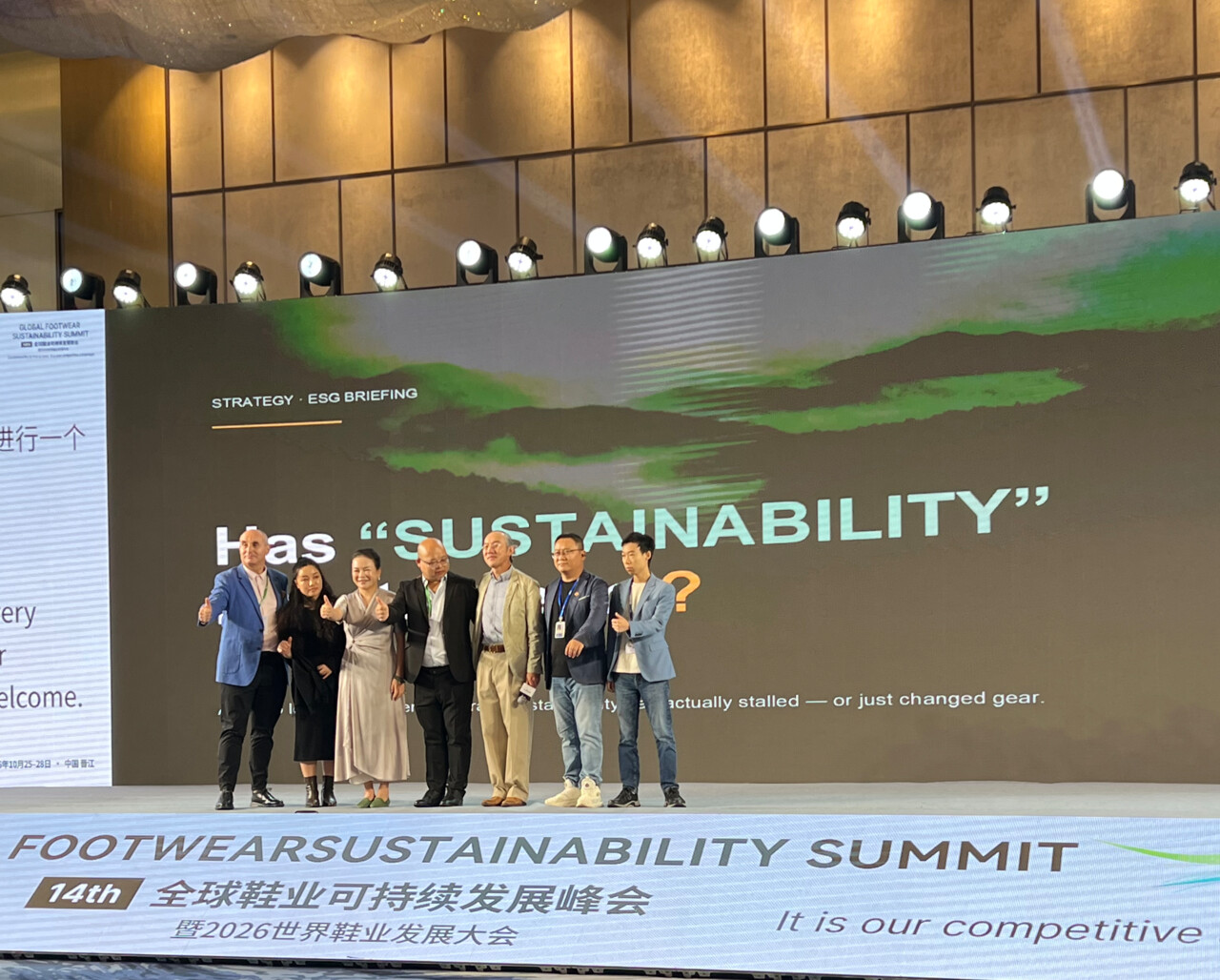
In Jinjiang, during the 14th Global Footwear Sustainability Summit, Changli Group unveiled its 200,000-square-metre logistics complex, due to become operational in 2027, and signed an agreement with SF International to measure the emissions of every footwear consignment.
At the 14th Global Footwear Sustainability Summit, it became clear that sustainability is measured in terms of costs, industrial scale, data and the ability to collaborate. Materials, digital technology and the dialogue between Europe and Asia were among the key themes.