The Tuscan conference of the Leather Chemists Association takes stock of the challenges facing the sector and reaffirms the importance of collaboration and teamwork within the supply chain
Company news ArsTannery
July 2026
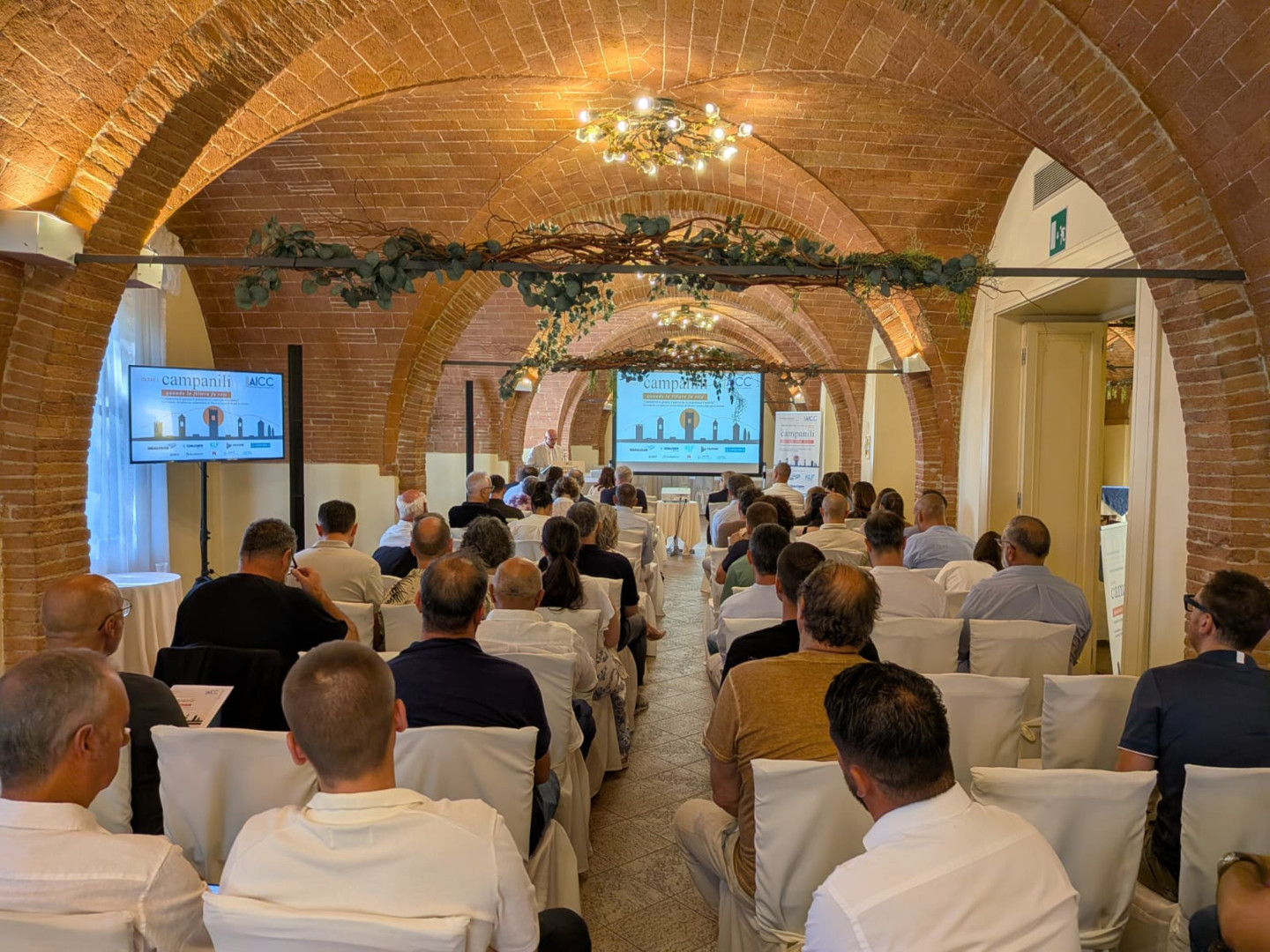
“Beyond Parochial Interests: When the Supply Chain Networks.” A title that already encapsulates the message of the AICC Tuscany Region Annual Conference, held on July 9 at Villa Sonnino in San Miniato. Reinforcing this message is an equally significant subtitle: “The goal is right: the path is built together.” A clear call to work as a team to tackle the major challenges facing the leather supply chain—from regulations to compliance, from sustainability to new prospects for the tanning industry.
Tomaso Pellegrini, president of AICC
The proceedings were opened by the new AICC president, Tomaso Pellegrini, who, after thanking his predecessors, reiterated a concept that would serve as the central theme of the entire day: “Together, by supporting one another, we can build the future. Let’s also try to address problems from different perspectives.”
Dario Nardella, Member of the European Parliament
Among the most anticipated speeches was that of Member of the European Parliament Dario Nardella, who has long been supportive of the sector’s concerns and is known for his commitment to excluding leather from the EUDR regulation. “Parochialism is anachronistic and harmful,” he stated, once again emphasizing the value of collaboration among stakeholders in the supply chain. Nardella then updated those present on the ongoing debate in Brussels regarding some of the most sensitive issues for the sector, including restrictions on polymers, PFAS, and bisphenols. “We are working to ensure that decisions on these matters are based on sound and accurate scientific data,” he explained. The Member of the European Parliament also returned to the topic of the EUDR, emphasizing that “when the sector presents a united front, results follow,” and finally announced the launch of a cross-party working group in the European Parliament dedicated to revitalizing the fashion and textile sector. The presentations titled “Driving Change: The Tanning Sector’s Proactive Approach,” delivered by Giulia Martin and Marta Montanari of UNIC – Concerie Italiane, explored, on the one hand, the latest technical updates regarding the EUDR and, on the other, the challenges related to environmental regulations posed by rules such as Ecodesign and the Digital Product Passport. Tiziana Gambicorti, head of AICC Tuscany and chair of CEN/TC 289 and IUC, presented a report focused on “New Analytical Methods for Tanning: The Case of Fluorine and Beyond” and reported on the work currently underway in technical working groups to develop and validate analytical methods that are still lacking, such as the method for total fluorine. In his remarks, Federico Brugnoli, CEO of Spin360, explained the importance of the new “Guidelines” for measuring the environmental footprint of leather, recently published by the United Nations Industrial Development Organization (UNIDO), which establish a fundamental principle: that leather is an animal byproduct that is “non-determinative” for environmental change. Developed with technical support from SPIN 360, the UNIDO recommendations represent a major step forward in the proper recognition of leather as a circular material. The floor was then given to Alberto De Conti, Sector Lead – Formulators at ZDHC, who outlined the latest developments in the Chemicals to Zero (CTZ) initiative, which this year introduced an additional level of chemical compliance—called “Aspirational” —following the “Progressive” level, which had been the highest to date. “It represents an opportunity,” explained De Conti, “to further differentiate oneself in the market by transforming technical effort into reputation.” Sabrina Frontini, director of ICEC, outlined the changes introduced by the new European directives and the challenges the sector faces in balancing the needs of the leather supply chain. She described the current context as “a perfect storm” for companies in the sector, inviting them to view the Italian Certification Institute as “a beacon and a shield” during this phase of transformation.
Cecilia Polizzi, a professor at the University of Florence, concluded the series of presentations by discussing “Networking on Water Treatment” and highlighting the importance of the Meta project, which has unfortunately been hampered by a lack of funding. The event concluded with a roundtable discussion on the central theme of the event, “Beyond Silo Thinking: When the Supply Chain Networks,” moderated by journalist and founder of Solo Moda Sostenibile, Silvia Gambi. During the debate and the Q&A session with the audience, concerns emerged among leather chemists regarding the growing proliferation of compliance requirements imposed by brands, the excessive number of certifications currently on the market, and the ever-tightening of these requirements.
A moment from the closing roundtable discussion, which included all the conference speakers
From combating greenwashing to the valorization of waste, through new technologies and processes with reduced environmental impact. The 54th AICC National Conference brought together expertise and experience to address the challenges of the tanning industry’s transition