MinervaHub: the strength of an integrated supply chain serving the luxury sector
It brings together 21 leading luxury craft businesses — from brass chains to crocodile leather — into a €227 million group. An unprecedented industrial venture.
Company news Arsutoria
April 2026
15 June 2023. The San Quirico S.p.A. holding company, owned by the Garrone family of Genoa, has completed the acquisition of 75% of MinervaHub S.p.A. for approximately €550 million. Those in the energy sector know the Garrones: they are the owners of ERG, the group that owns wind farms stretching from Crotone to Estonia, transforming wind into megawatts. Now, in addition to wind power, they own brass chains for luxury handbags, injection moulding machinery for technical soles, and a crocodile leather tannery in Pisa. The shift seems abrupt. In reality, not so much.
Long-established industrial families know that good investments are those in authentic quality found in skills that are difficult to replicate, built up over decades of successes, mistakes and adjustments. That is exactly what convinced San Quirico to back MinervaHub — not the appeal of luxury in the abstract, but the concrete nature of the specialisations the group was bringing together. MinervaHub was already something of a rarity back in 2023. What it has become by February 2026, visiting its stand at Lineapelle, is hard to categorise; it goes beyond the unusual.
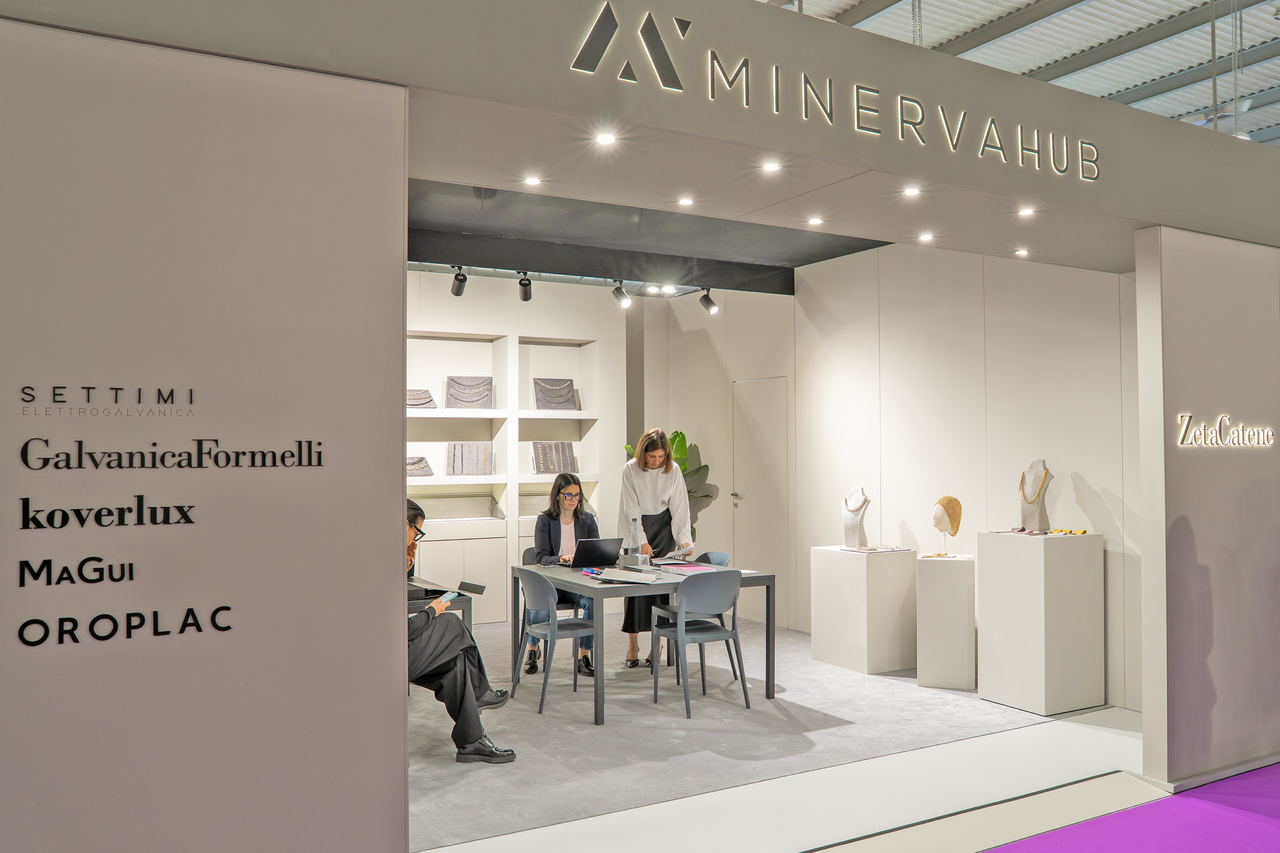
The MinervaHub stand at Lineapelle in February 2026
AN ECOSYSTEM
Rho Fiera, February 2026. MinervaHub collective, Lineapelle edition 107. The stand does not resemble that of an industrial group. It resembles an open workshop, where every corner showcases a different technology. Someone is holding a sample of an upper and bending it as if it were leather. «This is compact polyurethane moulded by casting and, here’s the innovation, two-tone. We can produce very thin thicknesses, under a millimetre, whilst retaining flexibility. These results cannot be achieved with standard injection moulding.»
This is the Non-Metal Accessories Business Unit in action. The sample is passed from hand to hand as they explain that it is produced using the CTT technique by Interlinea2 — the only company in Italy to apply this process. The process is simple to describe, complicated to replicate: the material is poured into an open mould on a rotary machine, the excess is scraped off, the fabric is applied and it is pressed. Everything is automated except for loading the fabric. The result: incredible geometries (reminiscent of lace embroidery, for example), softness, two-tone effects, and thicknesses that the Chinese competition — which produces similar items using manual labour — cannot guarantee with the same consistency.
This is the first insight Lineapelle offers on the group: MinervaHub does not compete on craftsmanship. It competes on the organisation of craftsmanship.
21 COMPANIES, 5 BUSINESS UNITS, A COMPLETE SUPPLY CHAIN
Founded in 2022 following the merger between Ambria Holding — the platform built by Matteo Marzotto, former president of Valentino — and XPP Seven (Xenon Private Equity), the MinervaHub group now comprises 21 companies spread across Italy’s main manufacturing districts, with a couple of branches abroad, over 1,400 employees and revenues exceeding €227 million.
Its client base exceeds 1,500 companies, with a list that includes Dior, Gucci, Valentino, Tod’s and Dolce & Gabbana. Led by Chairman Marzotto and CEO Alessandro Corsi — former CFO of Salvatore Ferragamo — the group is organised into five Business Units.
The first is ORNAMENTS: embroidery, quilting and decorative appliqués. It includes Jato 1991, one of the world’s most prestigious hand-embroidery houses, with an archive of over 6,000 pieces and a 200-strong workshop in India that combines traditional craftsmanship with Italian creative know-how. Then there is Quake, in Rossano Veneto, which specialises in machine-programmed embroidery and perforation — the same principle as embroidery, but instead of thread it uses a needle, creating patterns on leather and fabric with a precision of design that even lasers struggle to match. TrapuntaturaBelpunto, based in Treviso, specialises in roll-quilting and spot-quilting, using GRS (Global Recycled Standard)-certified materials, with 70% of production based in India. Finally (though there are other companies worth mentioning within this business unit), Goretti represents the cutting edge in applications and accessories for the leather goods, footwear and apparel sectors. The company stands out for its highly personalised approach, combining craftsmanship with advanced technology.
The second Business Unit is METAL ACCESSORIES. The highlight is MH Metal — born from the merger of Zeta Catene and Galvanica Formelli, both based in Arezzo and both founding members of the group — with a catalogue of over 2,000 types of brass and silver chains. Alongside this is Koverlux in Bergamo, the only company in the world capable of applying multiple finishes to a single metal piece. Then there is Oroplac, a historic electroplating firm in Scandicci with close ties to the brands of the Kering Group, and Elettrogalvanica Settimi in Pollenza (Macerata), with over forty years’ experience in precision treatments on small metal parts.
NON-METAL ACCESSORIES is the third, and perhaps the most technologically advanced. SP Plast Creating, in Fermo, boasts almost fifty machines for injection moulding, through-hole micro-injection, back-injection and digital printing. A leader in the processing of plastics and thermoplastic rubber. Gruppo Meccaniche Luciani, in Corridonia, started out as a moulding company and now integrates rapid 3D prototyping, additive manufacturing, EVA production and — through a partnership with DA.MI. — the production of DL FOAM, one of Europe’s first Super Critical Foams. Interlinea2, based in Altivole, Treviso, specialises in plastic moulding, overmoulding of thermoplastics onto leather and fabrics, micro-injection of labels, and thermoforming. Rounding off the list is New and Best, based in Barletta, which specialises in moulding various types of materials, such as fabric, leather and synthetics. It combines expertise, a creative approach and constant technological evolution to offer advanced processes in the sectors of leather goods, footwear (including safety footwear), clothing and high-end accessories.
Then there is PRECIOUS LEATHER, which includes the tannery Zuma PelliPregiate, a 6,500-square-metre facility in Pisa, specialising in CITES-certified exotic leathers: alligator, crocodile, python and lizard. It is linked to Audasit in Texas, which breeds alligators to ICFA certification and cruelty-free standards. A vertical supply chain from animal to bag, with full traceability. The kind of guarantee that Kering and LVMH have been seeking from their suppliers for years and rarely find in full.
THE GROUP’S SAMPLING COLLECTION AND THE PARADOX OF SCALE
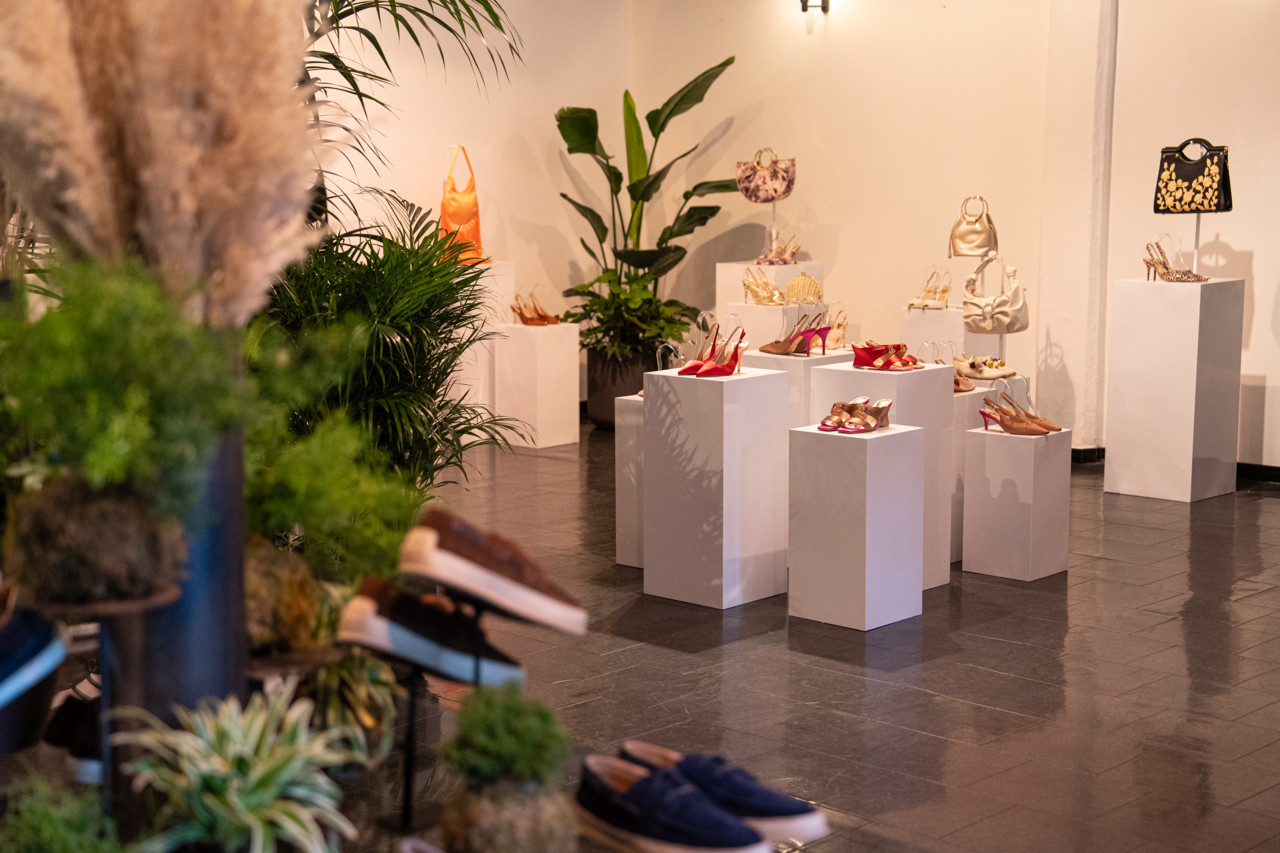
At Lineapelle, one of the most instructive corners of the area covered by MinervaHub seemed to us to be what the group informally calls the ‘sampling collection’: shoes and accessories created by combining the craftsmanship of six or seven different companies within the group. Soles by Luciani, uppers by Interlinea2, chains by MH Metal, embroidery by Jato 1991, appliqués by Goretti, heels with LTM pins — a company that produces metal inserts for women’s high heels and is currently the sole member of the LADY SHOES COMPONENTS business unit. These are not products ‘for sale’. They are demonstrations of industrial collaboration.
A buyer accustomed to coordinating six separate suppliers to achieve the same result looks at them with an attention that is not aesthetic wonder. It is calculation. A single point of contact for components spanning radically different manufacturing processes — from electroplating to expanded soles, from hand embroidery to injection-moulded plastic — means fewer emails, fewer parallel samples, and less risk of quality inconsistencies between successive deliveries.
Herein lies the paradox upon which MinervaHub has built its success: the bigger it gets, the more sense it makes for those who want to produce or buy small-scale and high-quality goods.
The global luxury sector is narrowing its supplier base. Brands are seeking partners who can guarantee traceability, volume and compliance all in one go. The small Italian SME — highly skilled in its specific field, often unique — struggles not for lack of expertise, but for lack of structure. MinervaHub addresses this problem precisely. It does so, however, without absorbing the acquired companies. The founders reinvest around 20% in the group, remain operational, and retain ownership of a stake. It is not a buyout and retirement. It is a buyout and co-investment. This explains the calibre of the people manning the stand: they do not have the demeanour of a multinational employee, but that of an entrepreneur who knows they can now do things they previously could not afford.
There is, however, one question that remains unanswered, and which deserves a response: is it really feasible to keep 21 entities with different corporate cultures, spread across eight Italian regions and two foreign countries, operating in five distinct technology sectors, together without losing along the way what made them unique?
The answer can only be complex. The theoretical model holds up. So does the governance. The figures hold up. But aggregation models that work on paper often get bogged down in operational details — in overlapping sampling priorities, in shared clients that create internal friction, in the temptation to standardise what should remain distinctive. It is not a theoretical risk. It is the occupational hazard of all industrial groups.
MinervaHub knows this. And it is precisely the stand at Lineapelle reminds that the ecosystem’s output is worth more than the sum of its parts. The impression, upon carefully visiting the stand, is that it works, and works very well.
THE MILLIMETRE THAT MATTERS
Let’s return to the upper sample we were given at the start of the visit. Less than a millimetre thick. As soft as leather, produced in an automated process that cannot be replicated elsewhere. It is not the technology that makes the difference, in this case. It is the idea that someone had to build a system around that technology capable of bringing it to market in a reliable, scalable and traceable way. This is MinervaHub, in essence: not a conglomerate that aggregates by size, but a platform that aggregates by purpose. Luxury does not need bigger suppliers. It needs more attentive and consistent suppliers. The Garrones of Genoa — the ones from the wind — understood this right from the start.
THE GROUP’S SAMPLES MinervaHub is a collaborative project centred on integration, experimentation and dialogue between areas of expertise. At Lineapelle in February 2026, it presented a narrative comprising new techniques, innovative processes and shared visions, capable of showcasing the group’s various business units and individual companies. This narrative unfolded around three main themes, conceived as areas of research and cross-pollination.
The first theme is dedicated to the world of sport, drawing inspiration from the geometries of basketball: bold lines, clean volumes and textured surfaces.
The second theme, on the other hand, opens up to the marine world and all things organic. The shapes become softer and more natural, drawing inspiration from mother-of-pearl, its irregularities and its reflections.
The third theme looks to the Italian 1930s, evoking the imagery of summer as depicted by Viviani, a Tuscan artist, and the geometries of a historical period that profoundly shaped Versilia and the tradition of Tuscan artisans.
ALL MINERVAHUB COMPANIES Audasit Inc. (USA), Conceria Zuma Pelli Pregiate (Pisa), Deadema (Forlì-Cesena), Elettrogalvanica Settimi (Macerata), Goretti (Ancona), Gruppo Meccaniche Luciani (Macerata), Interlinea2 (Treviso), ITTTAI (Treviso), Jato 1991 (Bologna), Jato Garments (India), Koverlux (Bergamo), MA.GUI. (Arezzo), MH Metal (ex Galvanica Formelli e Zeta Catene (Arezzo), LTM (Forlì-Cesena), New and Best (Barletta), Oroplac (Firenze), Quake (Vicenza), Sagiwa (Treviso), Sp Plast Creating (Fermo), Teknomabel (Bergamo), Trapuntatura Belpunto (Treviso).
Watch the video showcasing the Group’s sample collection presented by MinervaHub at Lineapelle:
For Spring/Summer 2027, the Women’s Collection focuses on sculptural heels and couture materials, whilst the Men’s Black Label collection embraces a Mediterranean casual style. The collections were presented at the historic Luciano Soprani showroom at 30 Via Morosini in Milan.
The Spanish brand presents a collection that interprets next season’s trends whilst remaining true to comfort, quality and attention to detail. At the heart of it all is ‘Made in Spain’ craftsmanship.
The Spring–Summer 2027 collection focuses on lightness, soft materials and the Goodyear Reverse construction. Alongside this, Onda: a trainer with an ultra-light, voluminous sole and a multi-layered upper.