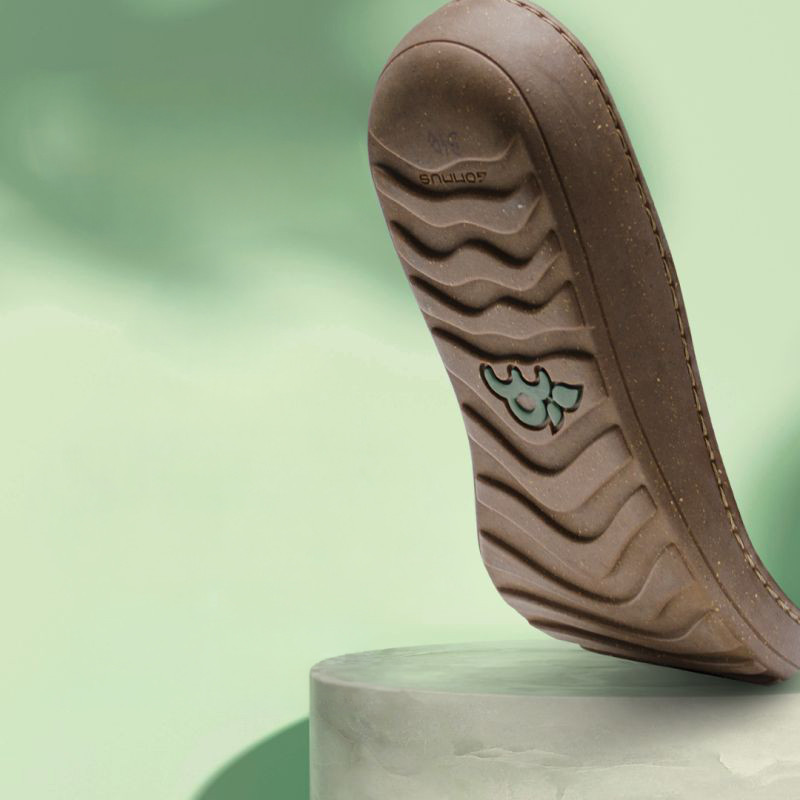
The company discloses the carbon footprint, the recycled content percentages and the certifications for each material: rubber, TPU, Blowtech.
Company news Arsutoria
April 2026
Take a look at a sustainability infographic — any sector, any company. You’ll usually find rounded figures, reassuring colours, and targets set for 2030. Rarely you find the carbon footprint broken down between upstream and the production process, measured per pair, and declared separately for three different materials. Go!Zero Recycle, however, does just that.
It is the range of recycled soles from Gommus, a Marche-based company certified to UNI EN ISO 14001 that powers its production almost exclusively with renewable energy. Three materials, three technical data sheets, three carbon footprints measured using the cradle-to-gate LCA methodology in accordance with PCR 2021:06.
The figures: for the rubber, 1.45 kg CO₂eq per pair, with 49.7% recycled material. At least 25% comes from internal production waste, certified by Bureau Veritas in accordance with UNI EN ISO 14021:2016. TPU: 0.67 kg CO₂eq per pair, with 97% recycled content — soles made from 100% recycled thermoplastic polyurethane, which retain the elasticity and abrasion resistance of traditional TPU. Blowtech, the super-lightweight compound: 2.06 kg CO₂eq per pair, with 29.8% recycled content. Also available in the Blowtech-GUM version, with a higher rubber content, for those seeking superior aesthetics and performance.
The paradox lies precisely in the data. The material with the highest percentage of recycled content — 97% TPU — is the one with the lowest carbon footprint. The more you recover, the less you emit. It is not automatic: it requires that production too be powered by renewable sources, otherwise the environmental benefit is lost in the process.
It is worth noting something else. For rubber, the upstream phase — extraction and processing of raw materials — accounts for 45% of the total footprint, whilst the internal process accounts for 55%. For TPU, the proportion is reversed: the core (A3) accounts for 88.7%, the upstream phase for just 11.2%. Recycled material drastically reduces the impact of the upstream supply chain.
‘Light footprint, Gommus quality’: the line’s slogan doesn’t lie, but it must be read in both directions. Light on the foot, light on the planet. One does not come at the expense of the other.
For Spring/Summer 2027, the Women’s Collection focuses on sculptural heels and couture materials, whilst the Men’s Black Label collection embraces a Mediterranean casual style. The collections were presented at the historic Luciano Soprani showroom at 30 Via Morosini in Milan.
The Spanish brand presents a collection that interprets next season’s trends whilst remaining true to comfort, quality and attention to detail. At the heart of it all is ‘Made in Spain’ craftsmanship.
The Spring–Summer 2027 collection focuses on lightness, soft materials and the Goodyear Reverse construction. Alongside this, Onda: a trainer with an ultra-light, voluminous sole and a multi-layered upper.