Biotech Open Platform: from the laboratory to the factory
Flash news
November 2026
Danone, Michelin and four other partners have launched an open platform in Clermont-Ferrand, worth over 20 million euros, to scale up fermentation processes to industrial levels; the platform is also open to external companies and start-ups.
A yoghurt and a tyre have more in common than meets the eye. Both are the result of a transformation of raw materials, and both depend on molecules that someone must produce in large quantities, at sustainable costs and to a consistent standard. It is therefore no surprise that Danone and Michelin have joined forces. The result is the Biotech Open Platform (BIOP), founded in 2024 in partnership with DMC Biotechnologies, Crédit Agricole Centre France, Clermont Auvergne Innovation and Greentech, which is launching its industrial biotechnology platform in Clermont-Ferrand, France, within the Sustainable Materials Centre at the Michelin – Cataroux Innovation Park.
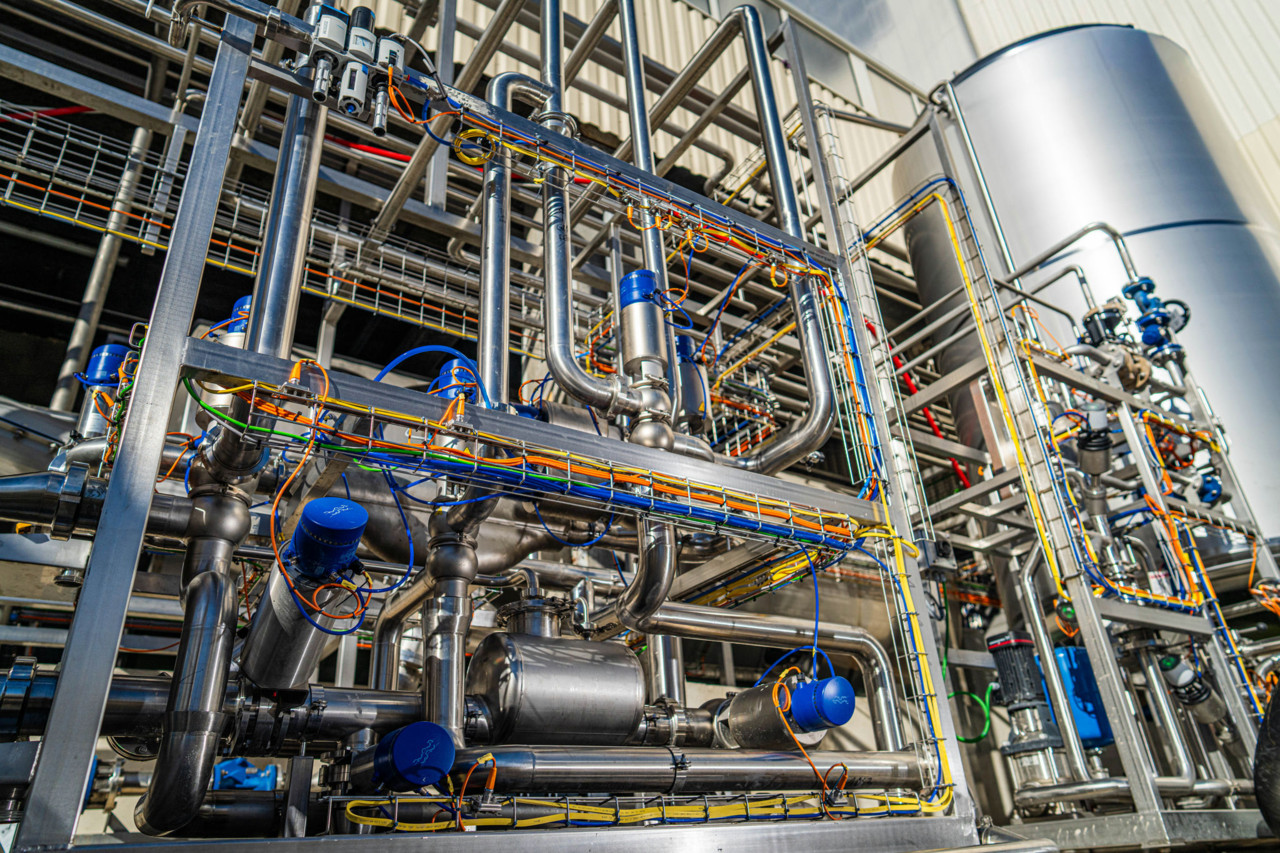
The problem the platform aims to solve is scale-up. Many biotechnological innovations work in the laboratory but then come to a standstill there, because between the feasibility trial and industrial production there is a step that is costly, requires facilities and expertise, and often holds projects back. Biotech Open Platform brings to the table over 20 million euros invested in the first phase, 5,000 square metres of space, a complete fermentation line with a capacity of up to 15 cubic metres, and semi-industrial purification systems – facilities that are still rare in Europe. The operating scale ranges from 10 grams to one tonne of ingredients. By 2026, the workforce will number 16.
What are we talking about? Advanced fermentation, of which precision fermentation is one of the main approaches: yeasts, bacteria, microalgae and fungi used as microfactories to produce proteins, enzymes, ingredients, active ingredients and bio-based materials. The sectors involved are food and drink, cosmetics, agriculture, chemicals and biomaterials.
What does footwear have to do with all this? Florent Menegaux, Chairman of the Michelin Group, says that for his company, the platform is ‘an opportunity to explore new ways of replacing certain molecules currently derived from petrochemicals with more sustainable bio-based alternatives’. Michelin is talking about tyres, but a rubber outsole, midsole foam, an adhesive or a finishing product share the same dependence on oil as a tyre. Those who develop materials or chemicals for footwear and leather goods come up against the same barrier: a formula that works in a test tube is not yet a material ready for mass production.
This is where the opening of the new centre comes into play. The platform is aimed at start-ups, industrial firms and research and development organisations, ‘well beyond the founding companies’. It enables the production of sufficient volumes for application testing prior to commercial production, whilst guaranteeing confidentiality and the protection of intellectual property. For a small business working on a biomaterial or a chemical auxiliary, building a 15-cubic-metre plant in-house is often out of reach. Renting the capacity, along with the expertise, is another matter altogether. Khadidja Romari, managing director of Biotech Open Platform, confirms this: ‘Infrastructure is important, but equipment alone is not enough. Scale-up requires experience, technical expertise and the ability to solve the problems that arise when moving from one scale to another.’ Many companies in the footwear sector would agree, having seen more than one promising material never make it past the sample stage.
The aim is to strengthen European industrial competitiveness and foster new value chains based on renewable resources. Biotech Open Platform offers what is often lacking for those who invent new materials: a place to make the transition from the laboratory to industry.
At the Green Economy General Assembly in Rimini, the transition was described as a structural necessity worldwide and as a process that remains challenging in Italy. The Forum for Good Communication discussed how to report on it without distorting the facts.
A mystery shopping study coordinated by the CEC on footwear purchased from SHEIN, TEMU and AliExpress in seven countries: 36 per cent do not comply with REACH, whilst 80 per cent of safety shoes fail EN ISO tests.
Around 500 participants, including brands, supply chain representatives, associations, universities and international organisations, came together to discuss how sustainability and digital technology can support the evolution of the fashion system.