Representatives from the leather supply chain turned out in large numbers for the General Assembly of the Association of Italian Leather Chemical companies, where on June 24 they also re-elected President Pierluigi Braggion for another two-year term
Company news ArsTannery
June 2026
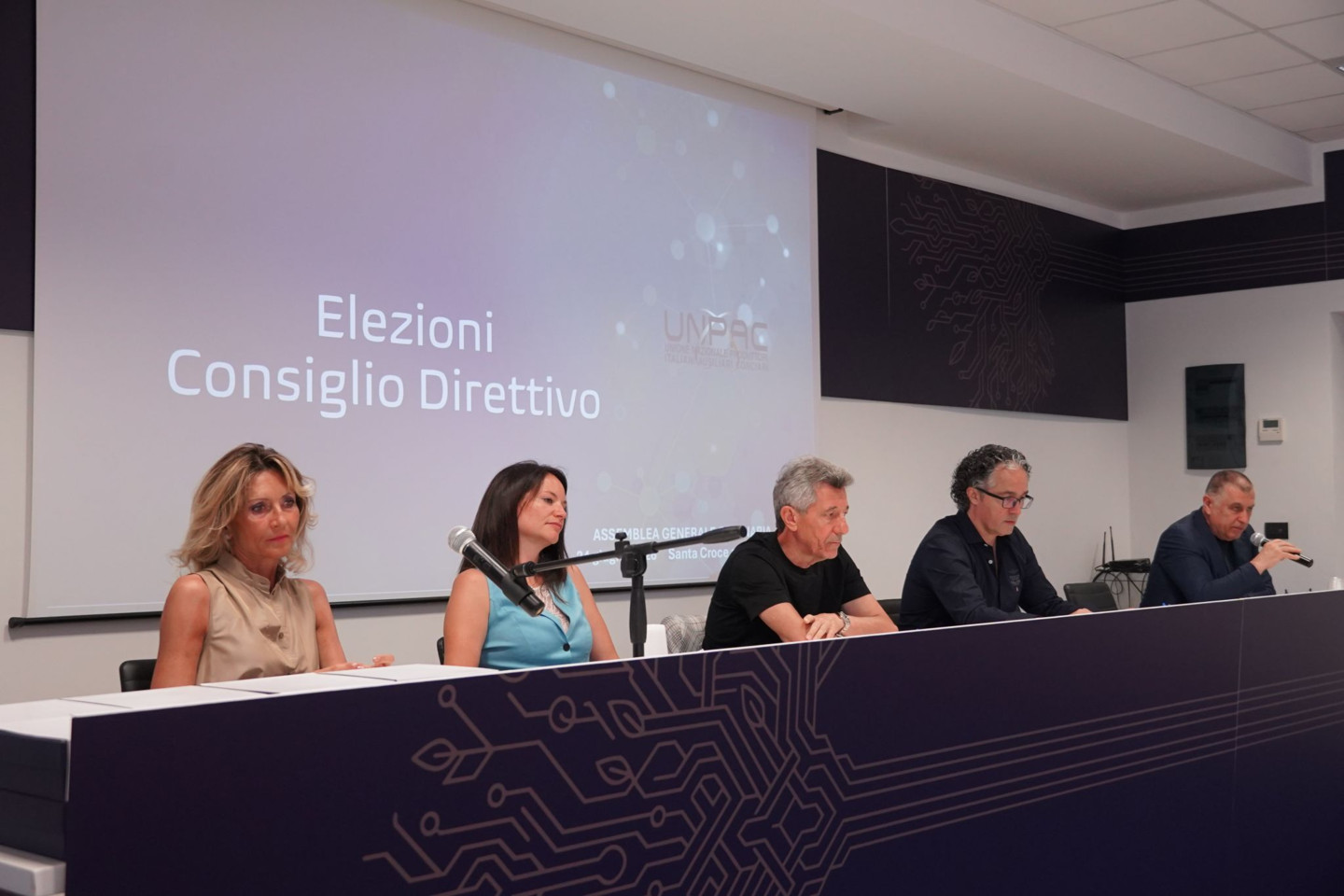
Rich in content, insights, and food for thought, the General Assembly of UNPAC-affiliated leather chemical companies—held on June 24 at the Po.te.co. headquarters in Santa Croce sull’Arno—offered a wide-ranging discussion on the sector’s main challenges. The meeting was further enriched by the participation of representatives from all associations in the leather supply chain and from local governments in the Tuscan district—a presence that demonstrated a renewed awareness of the need to work together as a unified system and address the challenges facing the sector with a shared approach.
The first guest to take the microphone was Fulvia Bacchi, general manager of UNIC – Concerie Italiane, who recounted the long battle waged by tanners to have leather excluded from the EUDR—an outcome now nearing final confirmation but achieved only after a process that, over the past two years, has required a considerable investment of resources and energy. Bacchi also expressed concern about the direction of European policies, which have allocated substantial investments to the bioeconomy and biomaterials, including funding for projects specifically dedicated to developing alternatives to leather. In her remarks, UNIC general manager concluded by thanking leather chemists for their “well-established” collaboration with UNIC, which is set to grow even stronger. This is confirmed by UNPAC’s recent admission to COTANCE as an associate member and the association’s presence with its own desk at the new Brussels headquarters of the European tanners’ confederation: initiatives that are part of a strategy aimed at ever-greater cohesion and representation of the entire tanning supply chain.
Pierluigi Braggion
The President’s Report Titled “The Power of Leather: Identity and Communication,” the address by President Pierluigi Braggion—who was reelected for the next two-year term—focused on the need to find a new way of telling the story of leather. “For years, sustainability has been approached primarily as a matter of compliance, reporting, and communication,” explains Braggion. “We are now witnessing the emergence of a new paradigm: shifting from an approach viewed as an additional cost to one that sees sustainability as a catalyst for evolution and industrial efficiency.” Hence the urgency to learn how to “highlight the role of the tanning industry as a strategic lever for preserving a millennia-old heritage,” including by raising awareness through the education of future generations. Not only that: “We must also invest in digitization and the integration of artificial intelligence, as well as in innovation, with a particular focus on product circularity and process sustainability.” It is in this direction that UNPAC has been working in recent years, developing “an identity-building project—the first and only one of its kind in the world”—which involves the creation of a database of chemical matrices for defining the LCA of leather tanning auxiliaries. Finally, a critical note was made regarding the proliferation of voluntary certifications, which “create an enormous and unjustified workload for the industry,” leading to the conclusion that “a single, harmonized audit and compliance system is needed, in which the drivers must be shared with the Italian tanning district.”
Technical Presentations The speakers who took the floor after the president, accompanied as always by Secretary Maurizio Maggioni, provided an opportunity to share visions, experiences, and perspectives on the future of the sector. Vice President Andrea Meucci reported on the results of UNPAC’s numerous activities carried out at the technical roundtables, while consultant Paola Ulivi (Danger and Safety) presented the general principles and application to the tanning sector of the new European regulation on microplastics, which requires careful attention. Francesco Troisi then discussed the challenges posed by the new ZDHC protocols, highlighting the valuable contribution that UNPAC has made—and continues to make—to the Progressive level of the Chemicals to Zero (CtZ) program, which is currently being defined. Arianna Civiletti (SPIN360), on the other hand, outlined the process undertaken by the sector to define the LCA of leather chemical auxiliaries, which involved 21 companies and led to the completion of twenty LCA studies for each member, resulting in the creation of a database of over 400 products. Other guests who spoke at the meeting included: Luca Tempesti (Poteco), Riccardo Bandini (Assoconciatori), Gionata Moroni (ASSA—Association of Contract Manufacturers), Riccardo Boschetti (Veneto Leather District), Agostino Apolito (ASSOMAC), Sabrina Frontini (ICEC), Renato Bertoli (ITS Cosmo – Green Leather Fashion Manager), Tiziana Gambicorti (AICC), Gianluigi Calvanese (Experimental Station for Hides and Tanning Materials), Roberto Giannoni (Mayor of Santa Croce sull’Arno), Fabio Mini (Mayor of Castelfranco di Sotto), and, via message, Geoff Holmes (President of IULTCS).
The Current State of the Leather Tanning Chemicals Sector The General Assembly provided an opportunity to take stock of the leather tanning chemicals sector, which today comprises 194 companies and 1,900 employees. In 2025, these companies generated revenue of approximately 810 million euros, with exports accounting for 39% of that total. There are 74 companies affiliated with UNPAC (with approximately 1,450 employees), generating domestic revenue of about 427 million euros and estimated foreign revenue of around 260 million. The future does not look bright. According to UNPAC, current market data point to a negative outlook for corporate revenues in the international leather supply chain by 2026. This negative trend is linked to geopolitical and economic tensions that are affecting the supply of raw materials and energy dynamics, which are having a significant impact on the supply chain. Weighing further on revenue is the decline in consumption of auxiliaries and commodities in the automotive and luxury sectors, which is expected to settle at around 13% for the current year, with Tuscany recording a volume decrease of over 20%, while for Veneto the decline stands at 8%. “ “Based on economic data and the current geopolitical situation,” explained Braggion, “our oil-based resources are not sufficient to counteract the current economic situation, which is weighing on our operations due to stagnant demand and price increases for basic chemicals, as well as energy-related tensions, which are estimated to have increased our costs by 15% compared to the previous year” .
The New UNPAC Board of Directors
At its annual meeting, UNPAC renewed its Board of Directors, re-electing Pierluigi Braggion as president, with Andrea Meucci serving as vice president and Laura Vantin as treasurer. The new Board of Directors is composed of: Massimo Baldini (Biokimica), Gianmario Cazzola (CGRD), Diego Cisco (GSC Group), Marco Frediani (KLF Tecnochimica), Francesco Lapi (FGL International), Andrea Meucci (Dermacolor), Andrea Montecalvo (Alanchim), Luca Pelfer (Alpa), Eric Poles (Silvachimica), Claudio Rosati (LMF Biokimica), and Laura Vantin (Chimica Vemar).
From combating greenwashing to the valorization of waste, through new technologies and processes with reduced environmental impact. The 54th AICC National Conference brought together expertise and experience to address the challenges of the tanning industry’s transition