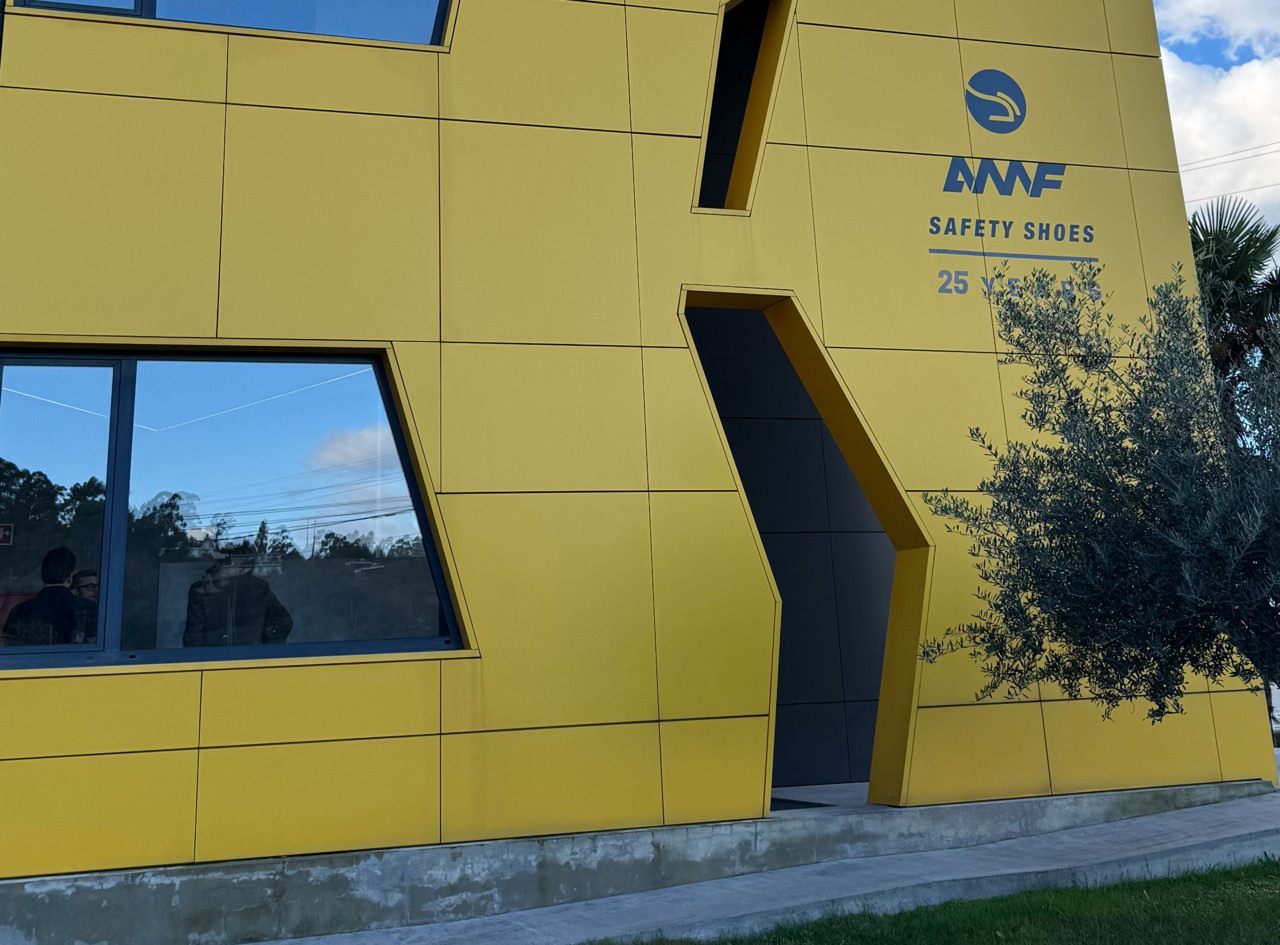
This is how AMF-Toworkfor is redefining the boundaries of automation in the safety footwear sector.
Company news Arsutoria
December 2025
AMF-Toworkfor, a world leader in safety footwear, is turning the acronym FAIST into a tangible reality. Innovative injection processes on uppers and high-frequency fusion of parts. Reducing production steps and improving product durability.
It starts with Fusion Cell injection: a dual-station system with a dual-density polyurethane injector that allows simultaneous moulding of soles and bonding of uppers. Translated: where multiple steps were previously required, now a single step is sufficient. The reverse mould configuration, with mould rotation to inject different parts of the shoe, integrates high-precision mixing, real-time monitoring and IoT sensors. The result? Uniform dosing, better adhesion, drastically reduced times and costs.
But the innovation does not stop there. The High Frequency Fusion Cell represents an evolutionary leap in upper production: sequential pressing that combines heat, cold stabilisation and high-frequency moulding. Multi-layer fabrics, TPU films, reinforcements and decorations are fused directly into the uppers, reducing manual operations and ensuring resistance to thermal, chemical and mechanical stress.
The third pillar is digitalisation. In collaboration with Softideia, AMF has developed Assembly Line Production Management 4.0: real-time order tracking, automated classification and intelligent workflows. A system that does not shy away from micro-orders, but rather processes them with the same efficiency as large orders.
For a company that supplies private labels to major international players in the sector, this triple revolution is not just a simple technological upgrade. It is a concrete response to a market that demands the highest quality, total flexibility and short lead times.
Industrie Chimiche Forestali S.p.A. has ended the year with impressive results despite challenging circumstances, confirming its leadership in the high-tech adhesives and textiles sector.
The Trissino-based group presents a production process that drastically reduces water consumption and a new S/S 2027 collection that celebrates the authenticity of the material.