

UNPAC joins COTANCE
The Italian Association of leather chemicals producers joins the Confederation of European Tanners
Keep reading...
From combating greenwashing to the valorization of waste, through new technologies and processes with reduced environmental impact. The 54th AICC National Conference brought together expertise and experience to address the challenges of the tanning industry’s transition
October 2026

The leather chemical sector gathered on Friday, October 9, in the picturesque setting of the Hotel Lloyd’s Baia in Vietri sul Mare, in the province of Salerno, for the 54th AICC National Conference. The focus of the event was the theme “Circular Synergy: Regulations, Chemistry, and Industrial Processes—An Alliance of Expertise for Sustainable Competitiveness.”
The event, which drew a large audience, proved to be an important opportunity for in-depth discussion of the challenges that are reshaping the sector: from growing European regulatory pressure to the need to make environmental performance measurable, to new technologies capable of combining quality, innovation, and circularity.
AICC President Tomaso Pellegrini opened the proceedings by highlighting the leather chemical sector’s capacity for constant innovation, while also emphasizing the importance of collaboration throughout the supply chain. Indeed, only through the integration of diverse areas of expertise is it possible to build a truly sustainable model of competitiveness.
The program got underway with a presentation by Luca Marrucci, a researcher at the Sant’Anna School of Advanced Studies in Pisa, who outlined the main provisions of the European EmpCo Directive—which has been transposed into Italian law and took effect last September—aimed at combating greenwashing. Marrucci explored the implications of the new regulation for environmental communication, which requires companies to review their sustainability claims and ensure they are supported by concrete and verifiable evidence.
The credibility of ESG strategies was the focus of the presentation by Serena Portella, Sustainability Manager at Muno, who explored the role of materiality analysis, impact assessment, and data quality in developing truly verifiable sustainability pathways. Particular attention was given to the LCA methodology, a fundamental tool for identifying critical issues in the tanning process and guiding improvement initiatives.
Innovation in production processes formed the backdrop for the presentation by Marco Cazzolla, R&D Finishing Specialist at GSC Group, who presented a comparative study on the environmental impact and performance of new cross-linking agents used in finishes for the automotive sector, highlighting in particular their effectiveness when combined with ultraviolet (UV) technology.
Dario Manolo, Technical Manager at Icap Leather Chem, spoke about the industry’s efforts toward more responsible chemistry without compromising the quality and technical performance of the finished leather. He outlined the role of organizations and tools such as ZDHC, LCA, and the Digital Product Passport in measuring and communicating the value of sustainable innovation.
In the second part of the conference, the focus shifted to concrete applications of the circular economy. Alberto Colella of Russo di Casandrino reported on the results of the RESCUE project (carried out under the MICS program), dedicated to recovering collagen from tanning waste for new production applications, emphasizing how the initiative has evolved from a laboratory concept into an industrial-scale reality.
The Chemical & Sustainability Manager at Vignola Nobile, Daniela Caracciolo (who was also responsible for the conference’s excellent organization in her capacity as AICC vice president), presented the European H2OxyTan project, developed by the Campania-based tannery under the MICS funding calls. The project involves the development of a sustainable tanning process using 90% biodegradable metal complexes and an innovative wastewater treatment method employing hydrogen peroxide and UV rays.
The automotive sector was once again discussed during the presentation by Luca Frighetto, R&D Chemical Research Manager of Pasubio, who outlined research on the reduction and monitoring of aldehydes conducted at the Veneto-based tannery using analytical approaches that serve as alternatives to today’s most widely used standards—research that has led to the optimization of formulas and the production of more sustainable finished leathers.
The role of scientific research in the sustainable transition of the tanning sector was the focus of the presentation by Claudia Florio, Head of Research and Development at the Italian Leather Research Institute (SSIP), who highlighted the fundamental contribution made by SSIP within the MICS Foundation through the promotion of projects capable of generating results of high scientific value and, above all, providing concrete solutions to the needs of businesses—as demonstrated by the two projects presented during the Vietri Conference. This initiative was made possible by collaboration between public and private partners, with the involvement of universities and research centers.
The floor then turned to Antonio Medici, also from SSIP, who spoke about the Smart Leather Quality project, dedicated to the use of spectroscopy and intelligent vision systems to improve quality control and the sustainability of tanning processes.
The final presentation of the day focused on wastewater treatment. Luca Pucci of Gori Spa—a company that manages water services in 75 municipalities across the provinces of Naples and Salerno—discussed the strategies and innovations developed in anticipation of the new European Directive on Urban Wastewater, which is expected to have a significant impact on both municipal and industrial wastewater treatment.
In conclusion, the conference confirmed that the sustainable transition of the tanning sector requires an integrated approach capable of bringing together scientific research, technical expertise, and industrial entities. The challenge is to transform knowledge and innovations into concrete, measurable solutions that can be applied to production processes. It is precisely through collaboration across the entire supply chain that solid, responsible, and future-oriented competitiveness can emerge.
The Italian Association of leather chemicals producers joins the Confederation of European Tanners
Keep reading...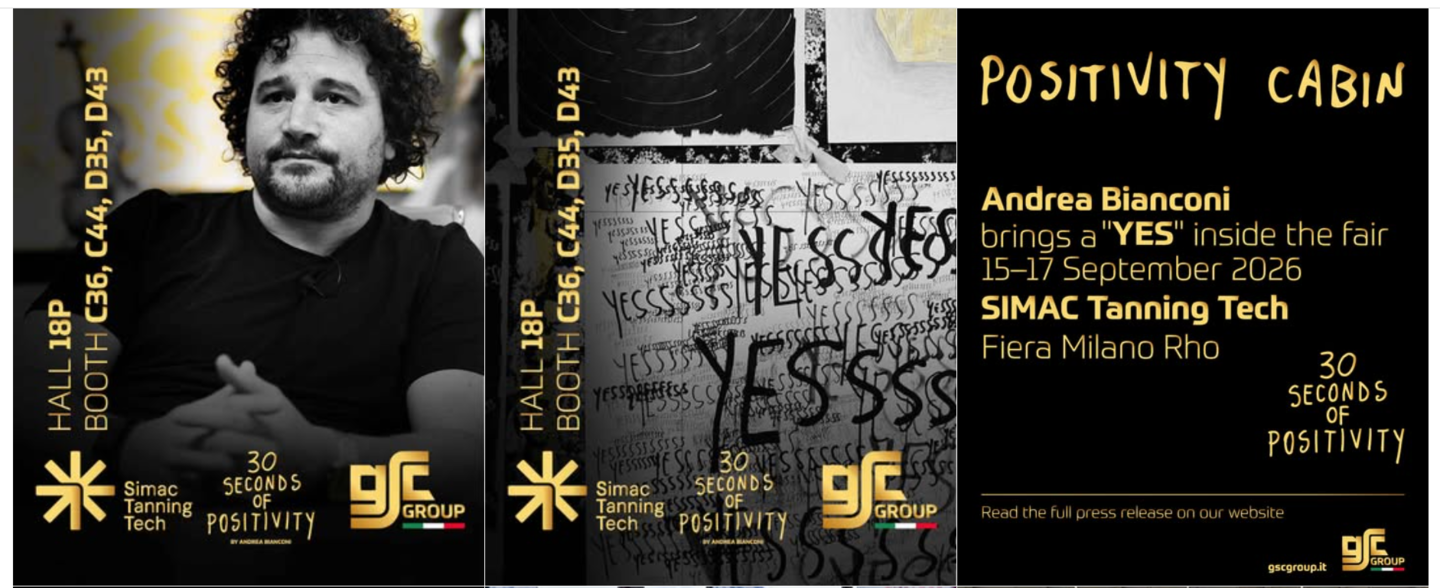
The leather chemical group presents Positivity Cabin: when a trade show becomes an experience
Keep reading...
The event will take place on Friday, October 9, in Vietri sul Mare
Keep reading...You must login to read this free content
This content requires a subscription to view. Are you already a subscriber? Sign in