AgroMateriae: biofillers derived from nature’s waste products/ingredients
The Tampieri Group company produces six biofillers from grape seeds, maize, sunflower seeds, olive pomace, eggshells and seashells. These are used in soles, midsoles and uppers, replacing mineral and fossil-based fillers.
Company news Arsutoria
November 2026
Alessandra Taccon
First, it is used in wine-making. Then it goes to distilleries, and sometimes finds yet another use. By the time it arrives in Faenza, at the Tampieri Vegetable Oil factories, the pomace seems to have nothing left to offer. Yet inside are the grape seeds – precious seeds from which oil is extracted. And after the oil is extracted, a final residue remains: the waste of the waste of the waste. This is where AgroMateriae’s work, guided by the principle of circularity, begins: transforming it into powders that end up in soles, adhesives and designer coatings.
A CENTURY OF OIL
Founded in 1928, the Tampieri Group now comprises eleven companies, employs over 370 staff and has a consolidated turnover of around 500 million euros. At the heart of its operations lies the processing of plant-based raw materials, with an annual production of 300,000 tonnes of oil for the food sector. Around this core activity, expertise has developed in the recovery of waste, the production of energy from biomass and the treatment of waste water.
AgroMateriae, on the other hand, was founded outside the group, following three years of research in the laboratories of the University of Modena and Reggio Emilia (Unimore). In 2019, it filed a patent application; in 2020, it was incorporated; and in December, it won the National Innovation Award (PNI). In July 2022, explains Alessandra Taccon, Executive Group Business Developer, the time came when scale and investment were needed: the company joined the Tampieri Group with a view to creating synergies. In 2023, it built its first pilot plant, and in 2024 it won the Lorenzo Cagnoni Award for Green Innovation at Ecomondo.
SIX INGREDIENTS
To date, AgroMateriae’s catalogue comprises six families of biofillers. Four are lignocellulosic: WineCore from grape seeds, CornCore from maize germ, SunCore from sunflower residues, and OliveCore from olive pomace. All utilise waste products sourced from between Faenza and Tuscany (Italcol is part of the group). The other two are biogenic calcium carbonates: EggCore, made from eggshells and composed mainly of calcite; and OceanCore, made from sea shell fragments and rich in aragonite.
All these ‘raw materials’ are by-products and waste from other industries, such as eggshells. “They are second-generation feedstocks, which are enhanced by our technology and given a new lease of life, without ever competing with food”, explains Taccon. The bio-based content is 96–100% in accordance with standard EN 16848; the carbon footprint is measured using LCA studies in accordance with ISO 14067; and the products hold RE-MADE certification, which covers the traceability of the recycled content. A new study on C14 content is also underway in collaboration with the French laboratory CTC.
FROM THE QUARRY TO THE EGG SHELL
Calcium carbonate is found everywhere: in cement, adhesives, paper and plastics. The traditional form is mineral-based and is extracted from quarries. “Whilst conventional calcium carbonate is derived from the extraction of non-renewable mineral resources, we now offer a viable biogenic alternative obtained from by-products of renewable origin”. Whilst for years nobody gave a second thought to how fillers were sourced, today this too is an important factor that needs to be traced. “The biofiller used to be an invisible element: the polymer, the main matrix, was declared, but the filler was not. Today, however, it has become a defining feature; its natural origin forms part of the material’s aesthetics and identity.”
Recovering food waste is beneficial for various reasons. Firstly, a material that already exists is recovered and transformed into a new raw material, rather than being disposed of. Secondly, the materials come from local supply chains, close to the processing facilities, thereby reducing land use and the consumption of virgin resources. The third: according to the company’s LCA studies, the carbon footprint of biofillers is ; in the case of EggCore, the carbon footprint is close to zero, at just 6–14 g CO2 per kg of product. The fourth: when added to certified compostable or biodegradable resins, biofillers can improve the rate of biodegradation and compostability.
EggCore and OceanCore replace mineral carbonate on a one-to-one basis. “It’s powders versus powders”,summarises Taccon, whose integration requires no changes to production facilities. The performance is entirely comparable. In some cases, customers report improved compound performance. For example, thanks to its aragonite content, the biogenic carbonate OceanCore can, in some cases, provide greater hardness and abrasion resistance in the final formulation compared to conventional mineral carbonate.
Soles by Selasti
SOLES AND FINISHES
In the footwear sector, there are two main applications for AgroMateriae’s biofillers. The first involves soles and midsoles. An example already on the market is the product offered by partner Selasti, which in 2026 chose to use biofillers to partially replace fossil-based materials in its soles, creating the ‘foodwaste’ range presented at Lineapelle last September.
The second is finishing: coatings applied to polyurethane or microfibre using maize or grape-seed fillers, which have already been tested and certified for applications such as car seats. With the appropriate testing, the same approach could be applied to the upper.
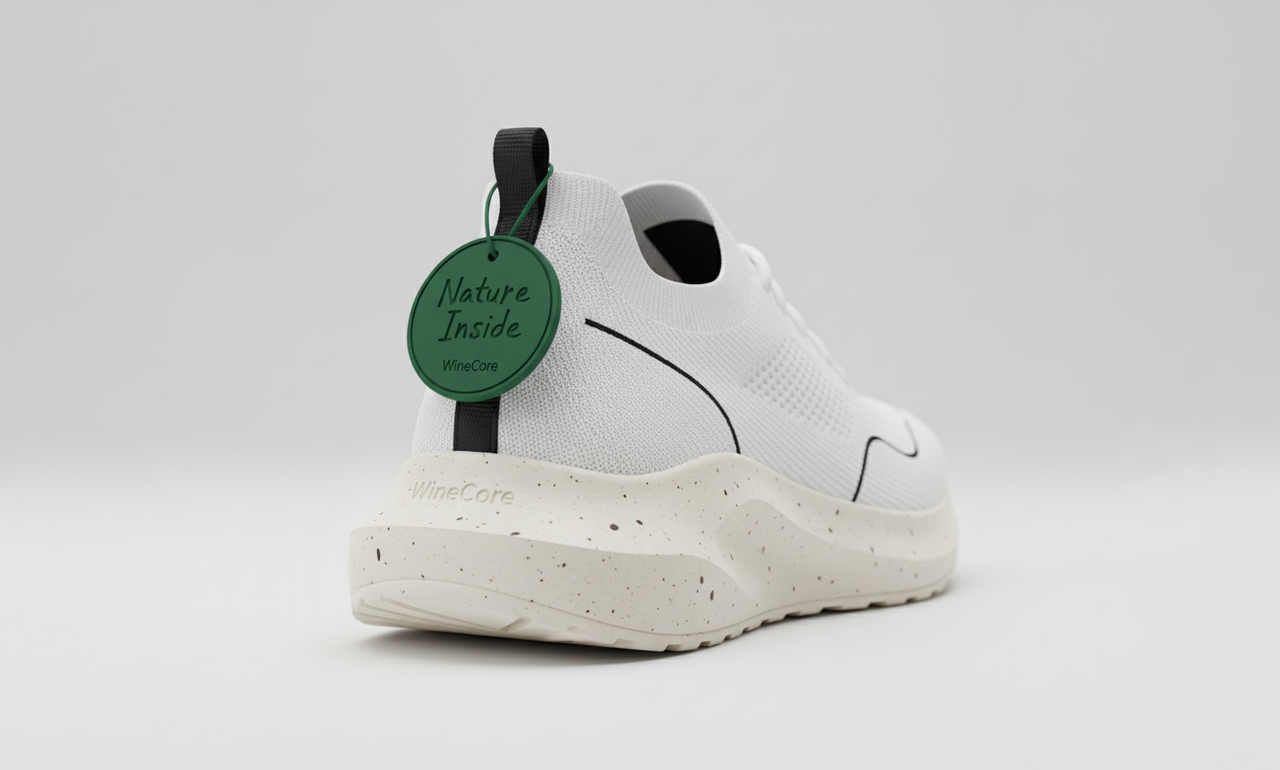
Biofillers also come in a ‘sand and fibre’ version: granules up to a few millimetres in size that give the material a fresh look whilst leaving the material visible. The ‘scrap’ effect becomes a style feature and serves to inform the consumer. The Nature Inside label indicates the presence of biogenic fillers in the product.
A PIECE OF THE PUZZLE
AgroMateriae sells an ingredient, not a finished product. “We are like a piece of a jigsaw puzzle in a product’s formulation: there’s a biopolymer, there’s a biofiller, there’s a bio-colourant”, explains Taccon.
And what about costs? Carbonate derived from shells, which is more complex to produce, remains a premium product. That derived from eggshells is already competitively priced and allows for economies of scale, whilst a European Union project could in future double the production capacity of the current plant, resulting in a further competitive advantage in the market.
In terms of design, AgroMateriae is already ahead of the game. Together with Cimento, it has developed ‘Madre’, a range of cementitious materials designed by Patricia Urquiola: tiles, stools and interior cladding for high-end retail outlets, showcased at the Salone del Mobile and Cersaie 2026. The sunflower and other biofillers serve a dual purpose here – as a filler and as a decorative element – with exposed granules that emerge from the surface, conveying beauty and creativity.
‘Madre’, the range of cement-based materials designed by Patricia Urquiola
From the discovery of expanded PTFE to the membrane without added PFAS: the history, the business model, the accounts with the climate and the work for those who operate in the risk. Four chapters on a material and on the promise that was built around it.
The Belgian start-up has developed a system comprising heat-sensitive threads and thermal machines that enables a product to be taken apart for repair, refurbishment or recycling. From 2026, the threads will be manufactured and distributed by the AMANN Group.
The long-established brand, which for almost 90 years has been developing rubber compounds and technologies that combine performance, reliability and durability, presents its new global marketing campaign dedicated to durability.