


GORE-TEX, fifty years from a cup of coffee

From the discovery of expanded PTFE to a membrane made without intentionally added PFAS: the history, the business model, the climate accounts and the work for people whose jobs put them at risk. Four chapters on a material and on the promise built around it.
History and philosophy
A cable, a sudden tug, a cup of coffee. And, since 1989, a guarantee on products Gore does not make.
The business model
What is sold is rolls of laminate. What comes with them is mandatory testing, a brand and a select few customers.
Sustainability
Emissions down from 212,000 to 171,000 tonnes while revenue grows. The supply chain remains the sticking point.
Firefighters
Moisture barriers, fabrics that char, and a boot that stays light even when wet.
Fifty years from a cup of coffee
From the discovery of expanded PTFE in 1969 to the expanded polyethylene membrane of 2022: the history of the GORE-TEX brand is also that of a guarantee which, since 1989, has linked the material to certified factories and to the consumer.
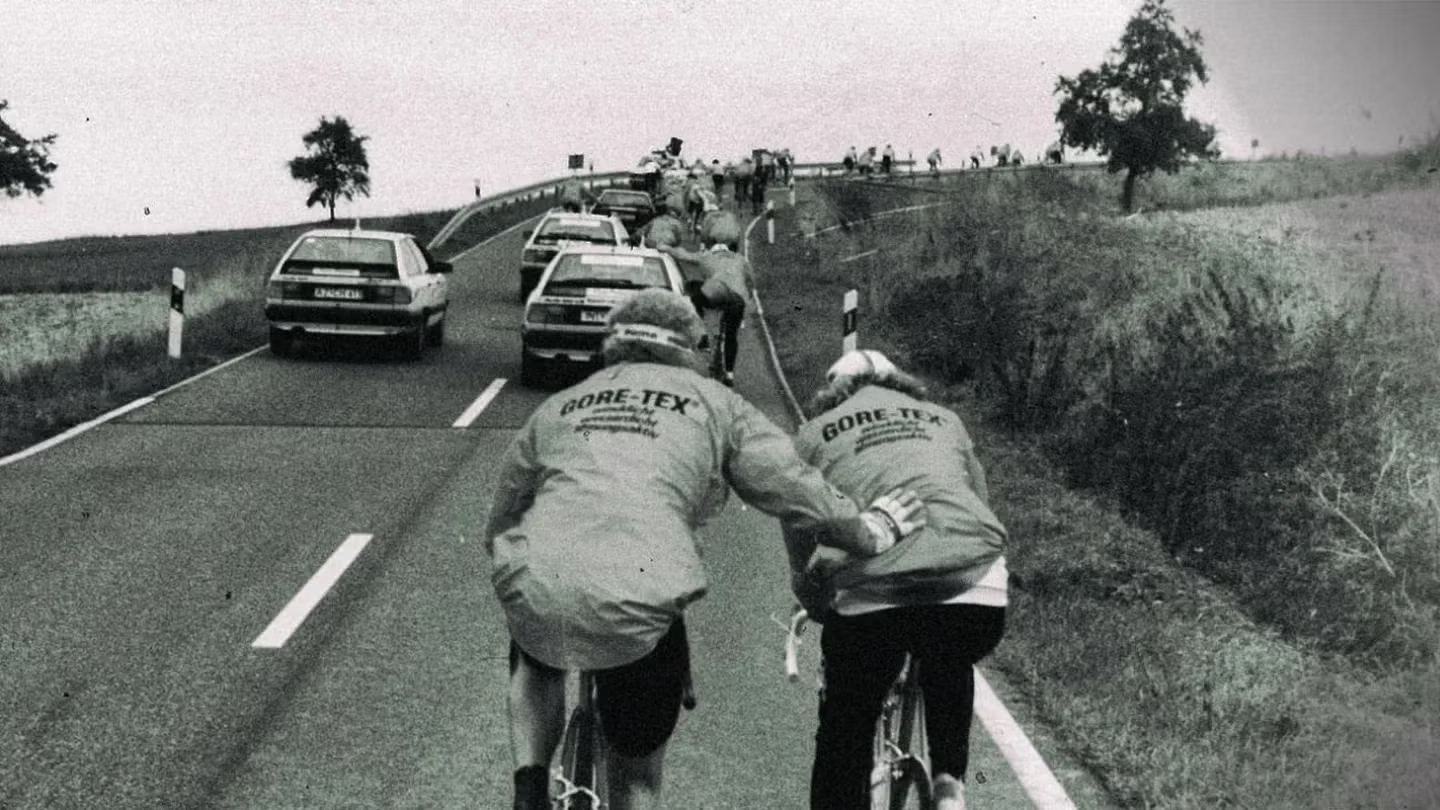
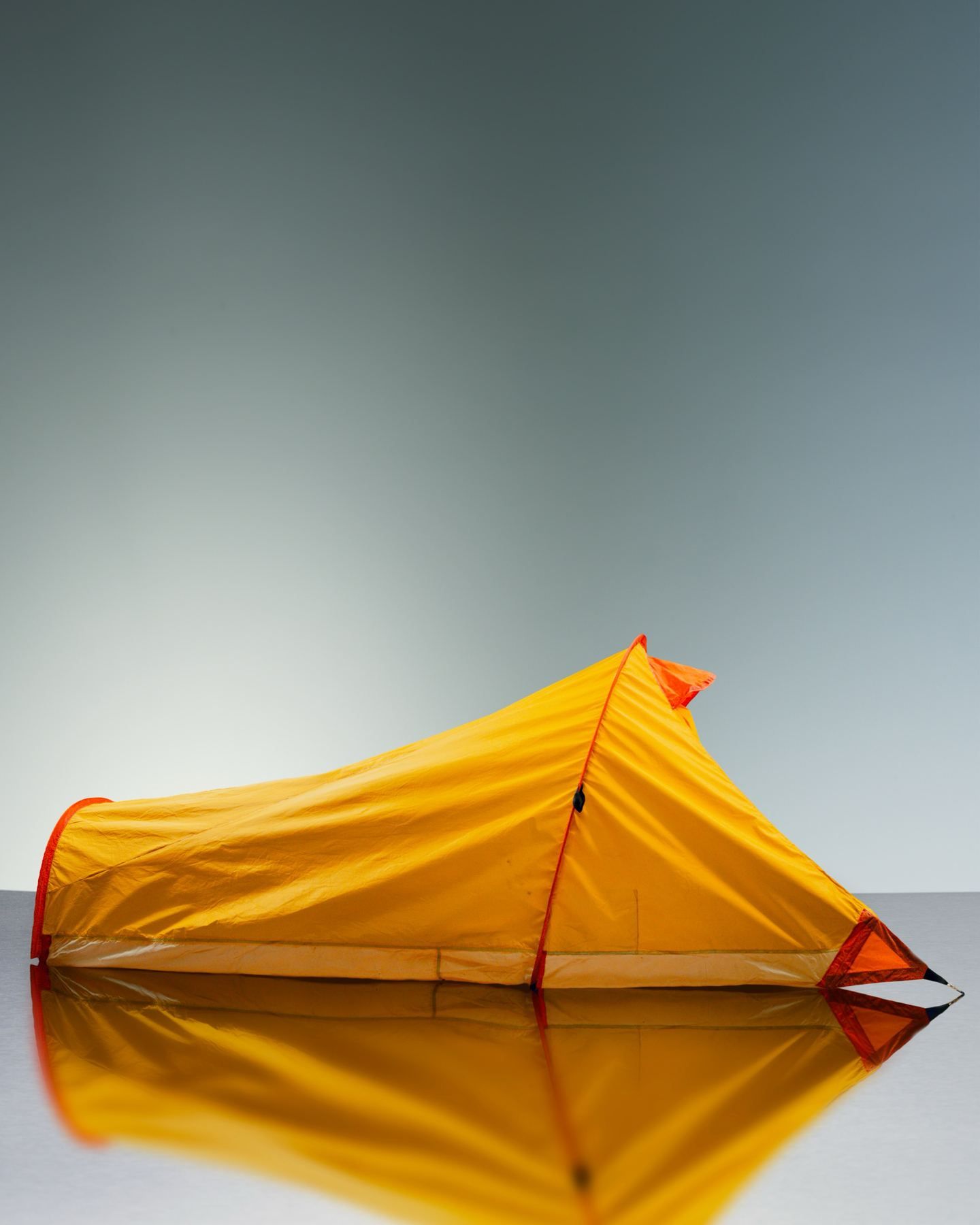
Seattle, 1976. Joe Tanner, one of the sales representatives at W. L. Gore & Associates, walked into the offices of Early Winters, a small independent outdoor equipment company, to present Bill Nicolai and Bill Edwards with a fabric nobody had heard of yet. Instead of explaining it, he demonstrated it. He took a cup of piping hot coffee, covered it with a scrap of the material and waited. The steam passed through the membrane; then he turned the cup upside down and the coffee stayed inside. Nothing more needed saying: shortly afterwards Early Winters launched the Light Dimension tent, the first consumer product made with GORE-TEX® fabric.
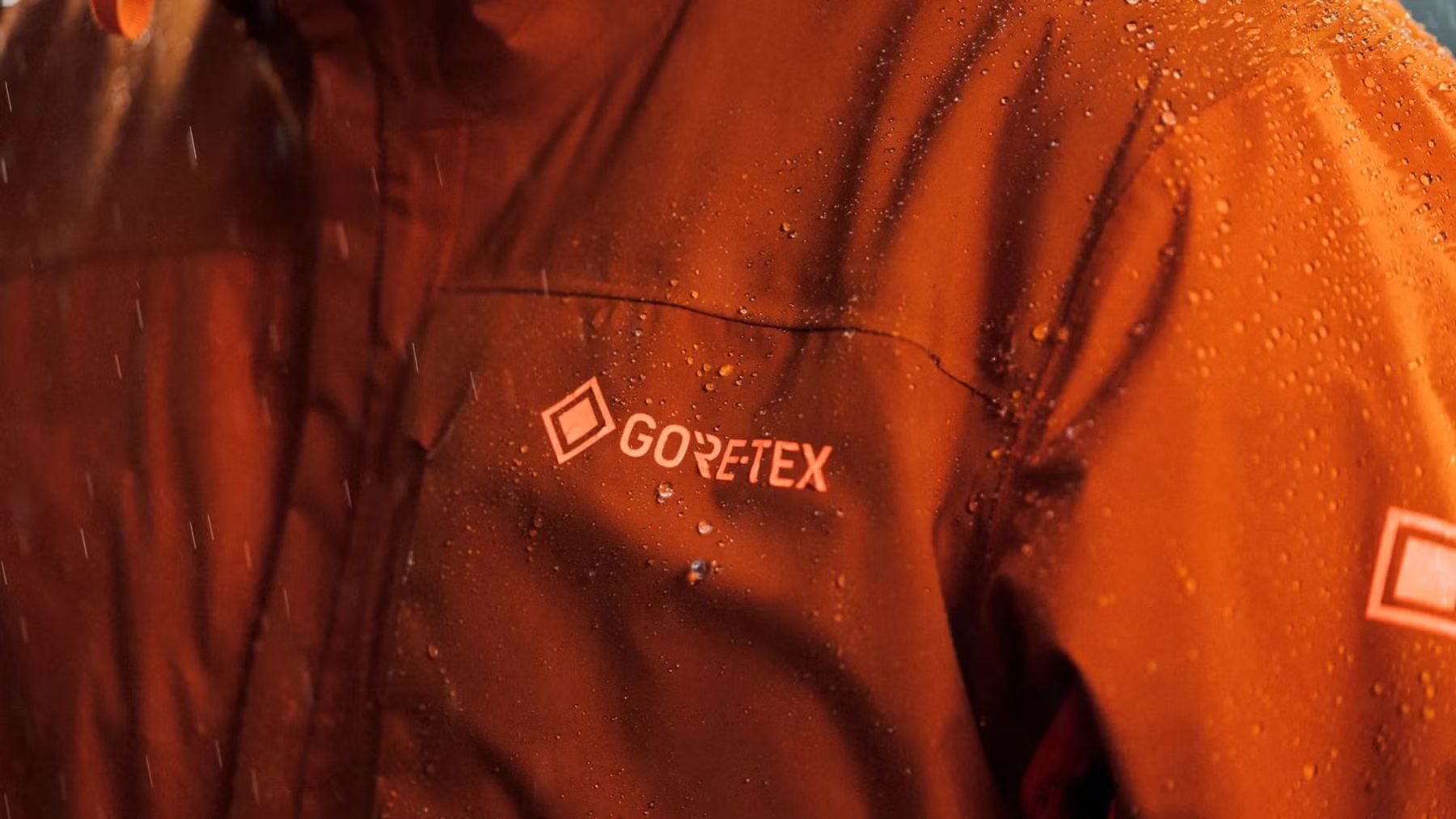
Fifty years on, that cup remains the simplest way to understand what a waterproof, breathable membrane does. Gore marked the anniversary with a slogan, ‘Going Further, Together’. Taken on its own, it is just another slogan. It becomes interesting if you trace how a company founded to make electrical cables became a benchmark in technical clothing and footwear, and why its value today lies as much in the material as in the promise it has built around it.
Vapour gets out, water stays out.
A basement and a few blades of grass
The story begins before textiles came into the picture. In 1958 Bill and Vieve Gore founded W. L. Gore & Associates in the basement of their home in Newark, Delaware. Bill had come from DuPont, where he worked as a scientist and engineer, and was convinced that PTFE – polytetrafluoroethylene – had potential nobody was exploiting. The company’s first product was not a jacket or a shoe but an insulated cable, intended for the aerospace and computer industries, two sectors growing fast at the time. The cables were made in the back garden, and the Gore family still recounts that a blade of grass would sometimes turn up inside them. It is a detail that raises a smile, given that the company now builds much of its reputation on quality control.
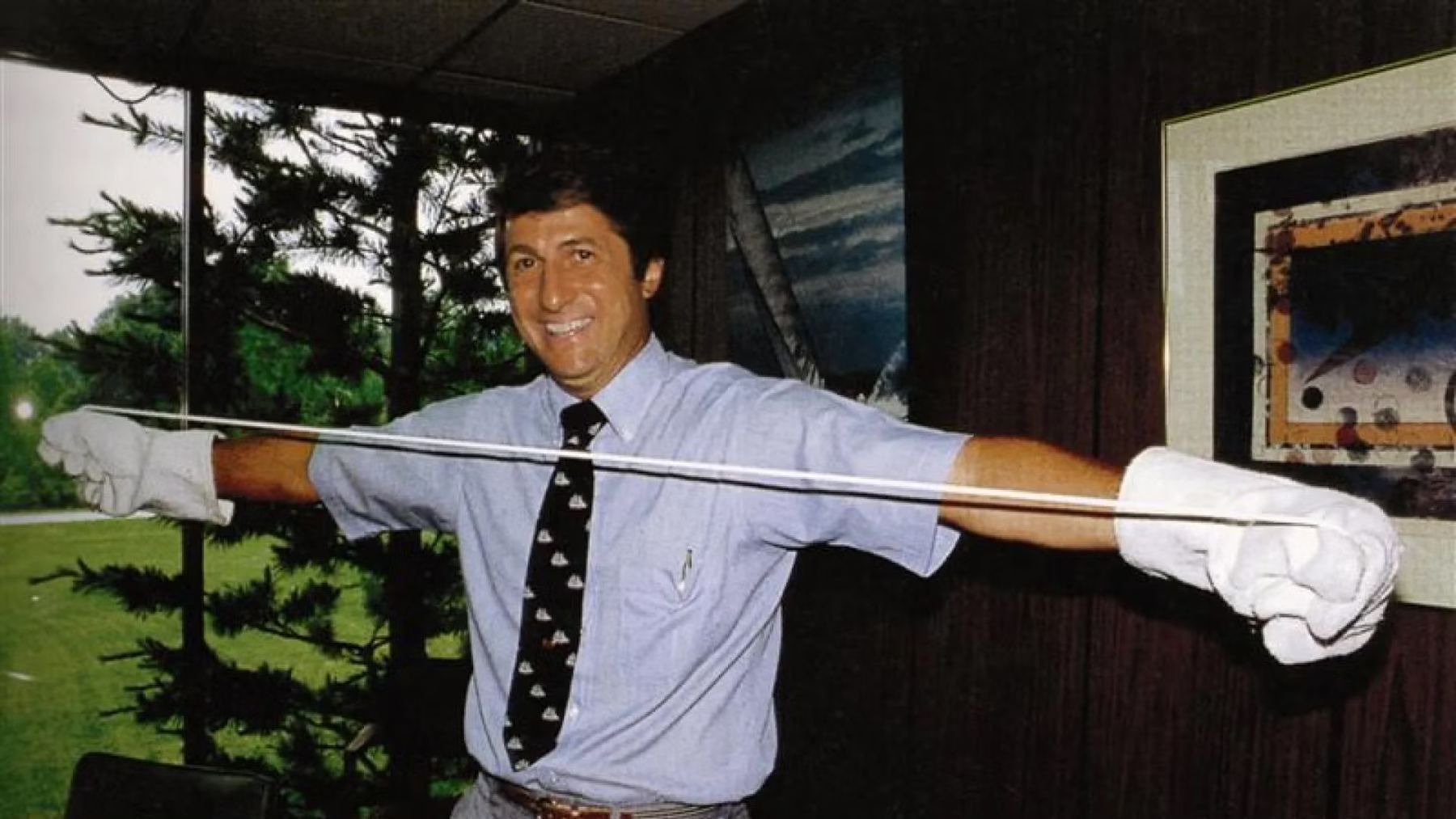
The turning point came in 1969 and has all the hallmarks of an anecdote. Bob Gore, the founders’ son, had long been trying to stretch PTFE after heating it. He pulled it slowly, patiently, but the material stayed rigid and would not stretch. Frustrated, as the company history tells it, he yanked it suddenly. With that rapid stretch the polymer was transformed: it became a new material, expanded PTFE, with a microporous structure running through it. Everything else stems from this discovery, not only in textiles but in the many other fields in which Gore still works today.
Nodes, fibrils and billions of pores
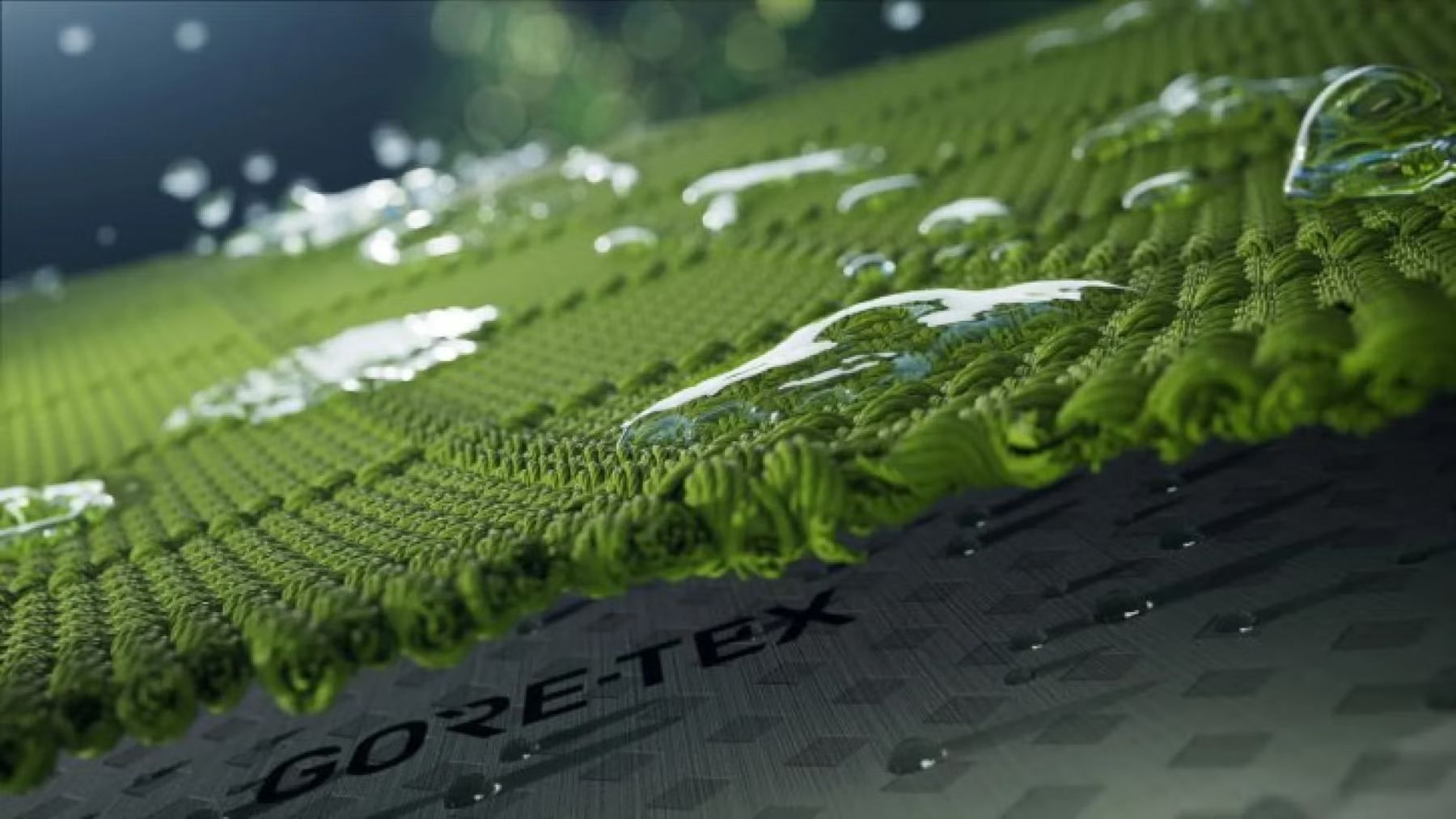
Yanked, the PTFE suddenly stretches and opens up: what remains are small nodes of material joined by extremely fine filaments, the fibrils. The spaces between them are the pores of the future membrane.
Why clothing, of all things? The answer lies in the family’s habits: they loved the mountains of Utah and knew one problem all too well. In those days, staying dry outdoors meant choosing between two inconveniences. Cotton soaked up the rain and turned heavy. Waterproof garments kept the water out but trapped sweat, and the wearer ended up wet from the inside. Waterproofing and breathability seemed irreconcilable. The microporous membrane reconciles them: it lets the vapour produced by the body escape and keeps water from getting in. Exactly what the famous cup of coffee would go on to show.
Photo: Bob Gore stretching expanded PTFE, W. L. Gore & Associates archive. Animations: explanatory diagrams, not to scale.
From tents to boots
After the tent came clothing, and here too it all began with a field test. In 1976 the founders of Marmot asked whether the material would keep them warm and dry for an entire night inside a sub-zero cold store. The test was a success, Marmot became the first brand to offer insulated garments with GORE-TEX fabric, and a collaboration began that continues to this day: it is the brand’s longest-running partnership in outdoor clothing. The following year the membrane reached Europe with the Norwegian brand Norrøna, which made the first European prototype jacket and put it to the test in the Alps, the Pyrenees and the Scottish Highlands. In 1978 Reinhold Messner and Peter Habeler climbed Everest without supplementary oxygen, equipped with a tent and a Millet jacket made from GORE-TEX fabric: proof that the protection worked even in the most extreme conditions.
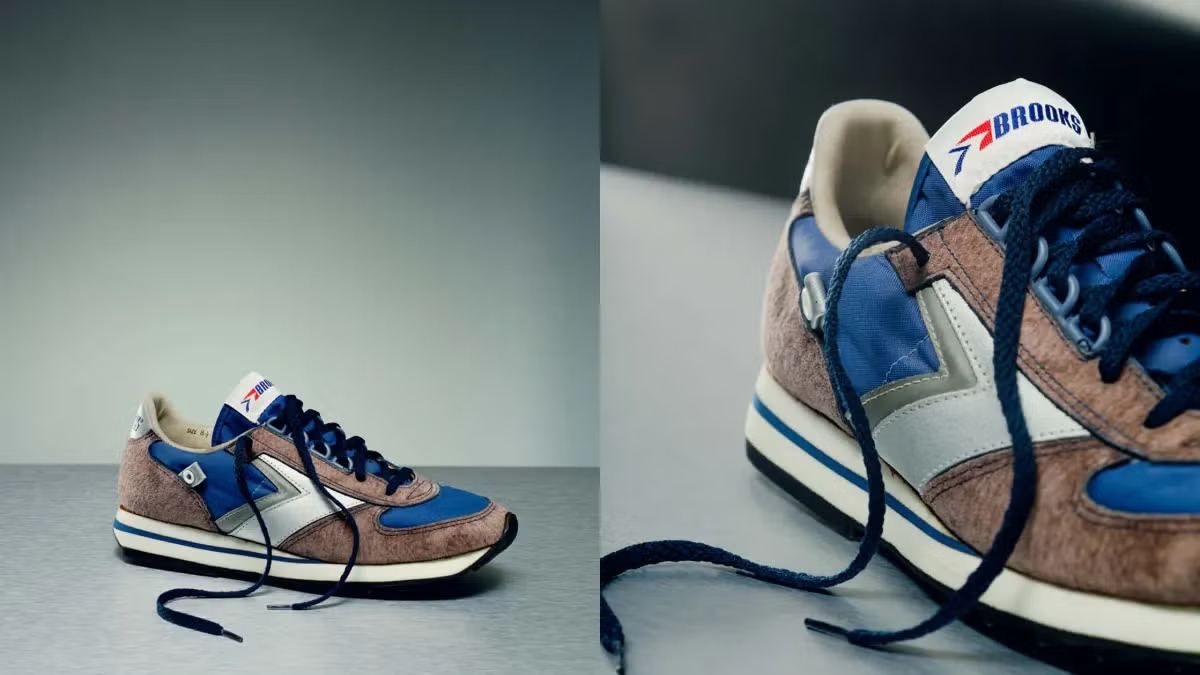
For anyone in footwear, the date to remember is 1979, when Brooks launched the Hugger GTX, the first running shoe with the membrane. In 1980 Danner introduced the Danner Light, the first waterproof GORE-TEX boot, while Nike brought out one of its first hiking shoes with the same technology; the Meindl Trailer followed a year later. Also in 1980, the women’s brand Golo used the membrane in its high-heeled boots, the first casual footwear with GORE-TEX. Within a few years, then, the membrane had moved from the mountains to the city: a foretaste of what would happen, on a far larger scale, forty years later.
Meanwhile Gore learnt a lesson that would shape the way it worked. A waterproof fabric is not enough if water seeps in through the needle holes left by the seams. Before 1979, customers had to seal the seams of their garments themselves, with products such as Seam Stuff sealant. GORE-SEAM tape, and the machine to apply it, solved the problem at the root. The point is broader than it seems: performance depends not only on the membrane but on how it is made into a garment or a shoe. That is why, from the start, Gore has looked at the end use and not just at the material it ships.
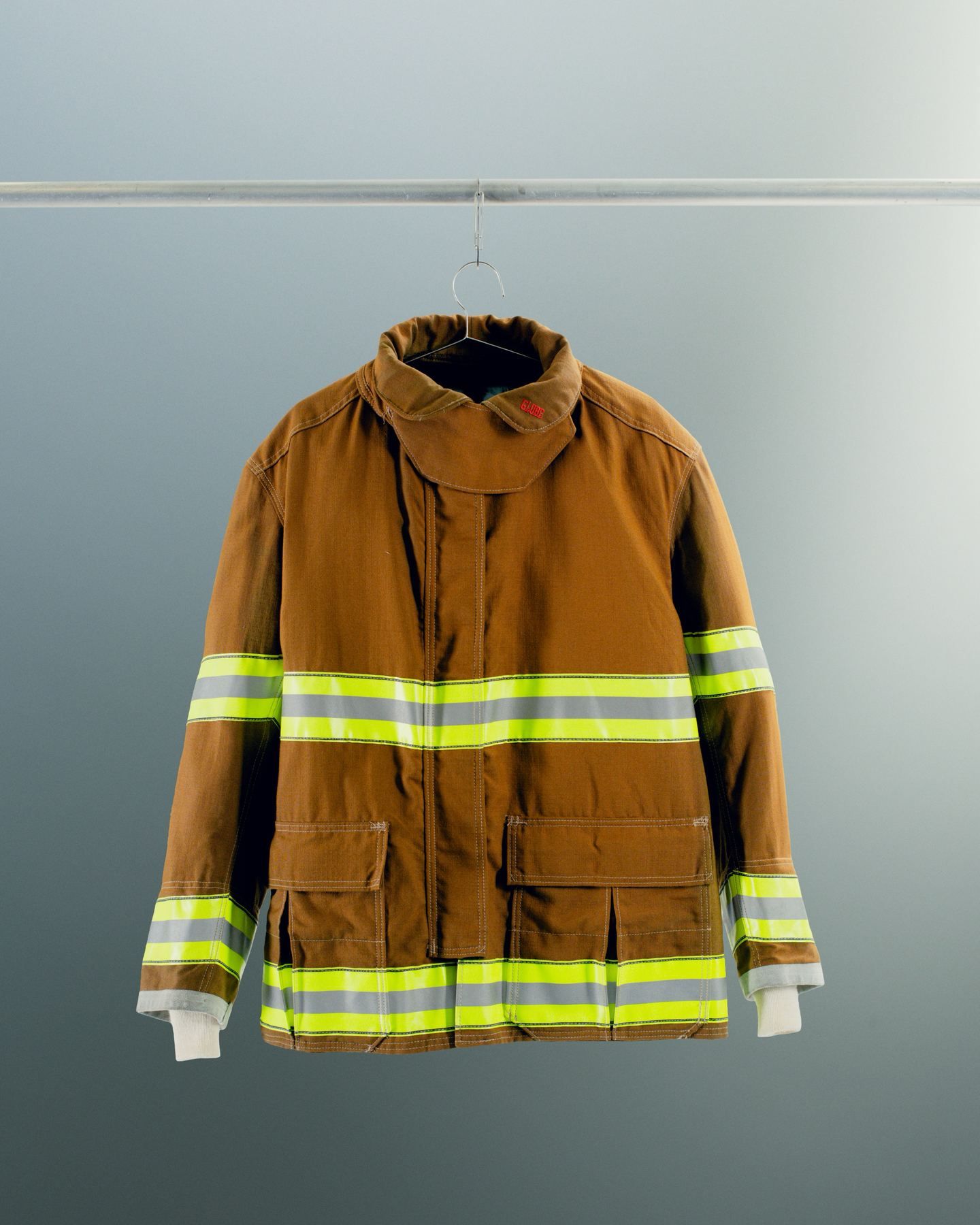
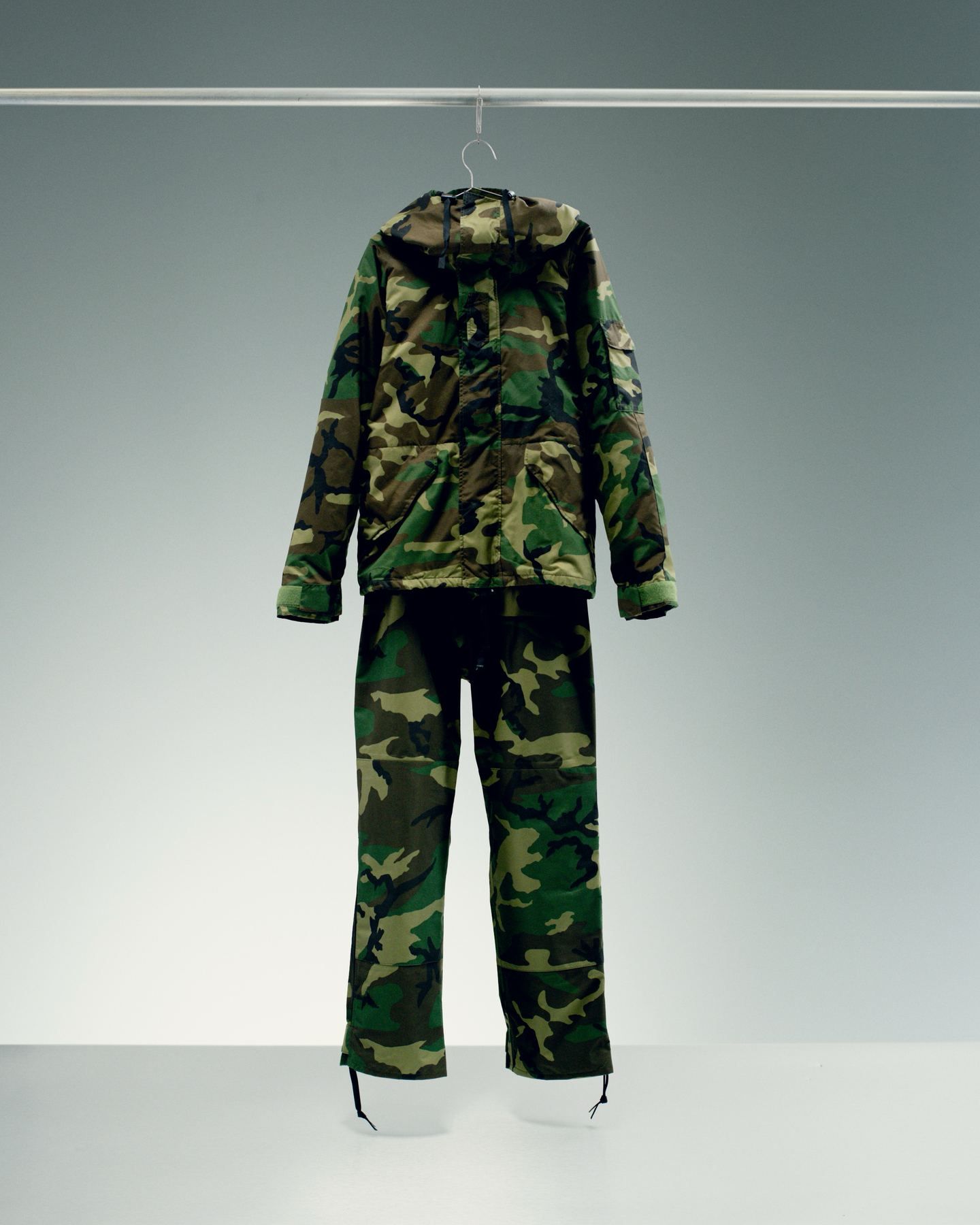
Work for professionals also began in those years. In 1979 came the breathable moisture barrier for firefighters’ clothing. From 1983 the US armed forces tested GORE-TEX products in the ECWCS (Extended Cold Weather Clothing System) programme for extreme cold, with garments capable of operating down to −40 °C.
The promise before the logo
If performance depends on how the finished product is made, then the finished product has to be tested. That was the reasoning that led, in 1985, to the ‘Raingear Without Compromise’ programme: manufacturers sent in their prototypes and Gore tested them under water jets, in the laboratory and in a climate chamber. In 1987 the first Rain Room was built, a room capable of pouring up to 56 centimetres of water an hour onto a garment; to this day, every garment with a GORE-TEX membrane goes through prototype testing in one of these chambers.
The next step, in 1989, was the ‘Guaranteed to Keep You Dry’ promise. Gore promises consumers that the product will be waterproof, windproof and breathable; if it is not, it will be repaired, replaced or refunded. It is worth spelling out what this means: Gore guarantees an item it does not make, namely another brand’s jacket or shoe. To do so, it has to influence the whole supply chain, upstream and downstream. Since then, anyone who wants to use the technology has had to manufacture in Gore-certified factories, where processes are verified and quality control is shared. Inside the company, this decision is regarded as one of the most important innovations in its history, even though it is not a product.
The brand itself came about the opposite way round from the norm. It did not start from a marketing story but from an invention. The first logo, in 1976, was almost an explanation of how the membrane worked. For years the job was to build trust through performance, one test after another. The guarantee turned that technical benefit into a human one: the safety of the person wearing the product, whether a hiker caught in the rain or a firefighter inside a burning building. Gore describes this journey as a sequence in which the order matters. First comes performance, then trust; only once trust is there do partners want to work with you. To its values Gore adds imagination, meaning the ability to understand what the people wearing its products will need tomorrow.
Fit for use, every time
The principle that holds all this together is called ‘fitness for use’. The idea is simple to state: every product must work for the purpose it is intended for. If you are developing a running shoe, you have to keep the runner in mind; if you are developing a ski jacket, you have to think about the skier. Gore translates this principle into three requirements: a serious commitment to science, in-depth knowledge of the activities in which the product will be used, and a thorough understanding of the product itself.
In practice, this means extensive testing at several levels. Individual components are tested, then the laminate, then the finished product using partner brands’ models, right through to the comfort perceived by the wearer. Tests are carried out in the laboratory and in the field, on new products and after ageing, to industry standards and to tests that Gore has modified or developed itself. The aim, as stated in its presentations, is for the product to work first time, every time.
From rock face to catwalk
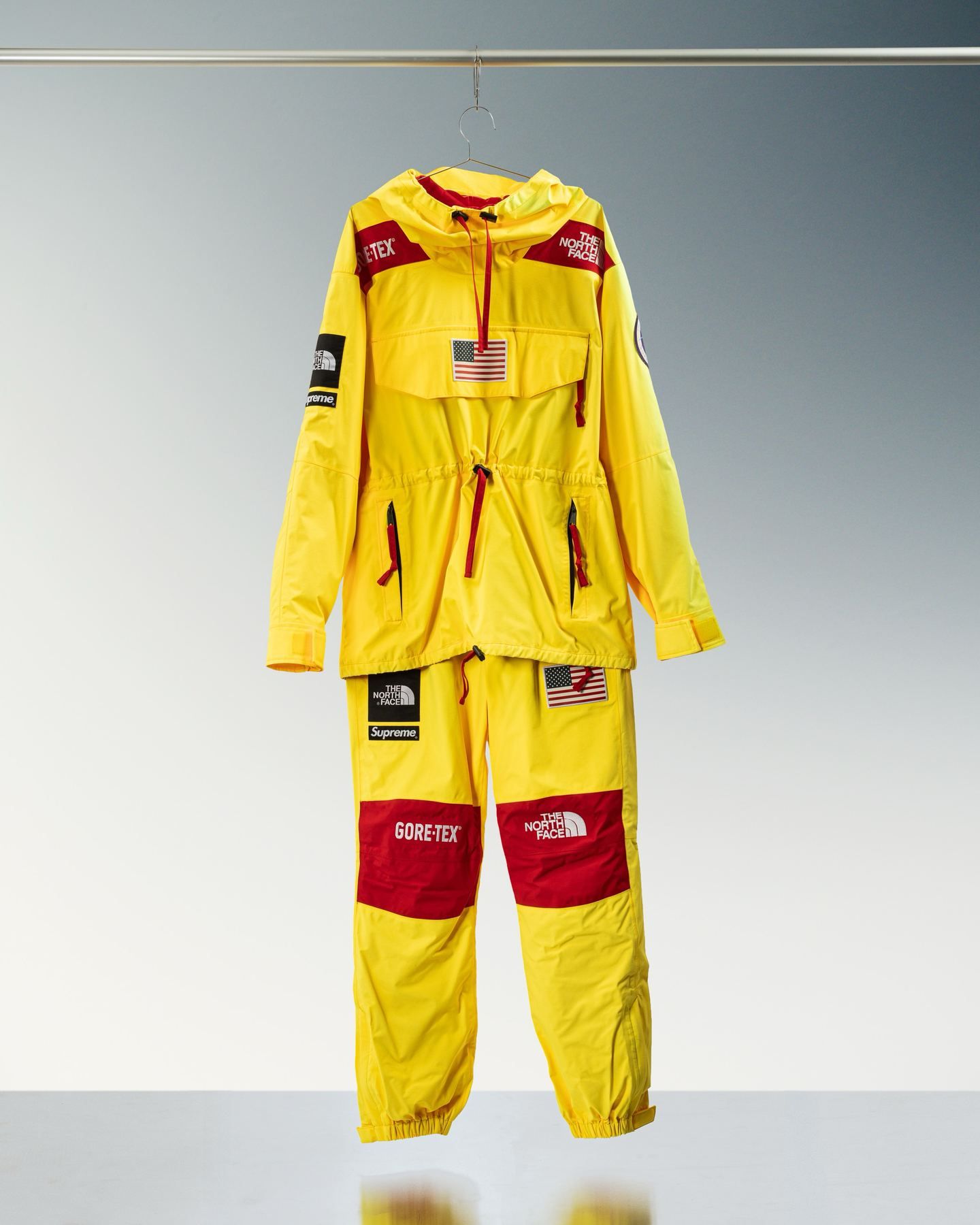
In its second quarter-century the brand reached places few had expected. In 2005 designer Junya Watanabe of Comme des Garçons brought GORE-TEX garments to Paris Fashion Week: clothes designed for hiking entered high fashion. Then came the trainers. In 2014 ASICS launched the GEL-Lyte V GTX, one of the first everyday trainers with the membrane; it was followed by the Converse Chuck 70 GTX in 2017 and the Nike Air Force 1 GORE-TEX in 2019. In 2018 the first collaboration with Supreme sold out in 6.4 seconds, a sign that high-performance technology had fully entered streetwear culture. In 2021 Zegna worked with La Sportiva and GORE-TEX on high-fashion looks built from outdoor materials.
On this point Gore is unequivocal. It does not want to become a lifestyle brand; it wants to be relevant in that world too. And it spells out the condition: the logo does not go on just any product, but only where it brings a real functional benefit. From designers and creatives, on the other hand, Gore says it wants to learn, to understand what drives people and what needs will emerge in the years ahead.
A change of material
The latest shift is also the most radical, because it concerns the very material on which everything was founded. After fifty years built on expanded PTFE, in 2022 Gore introduced the expanded polyethylene (ePE) membrane, made without intentionally added PFASPer- and polyfluoroalkyl substances: highly stable chemical compounds that persist in the environment and are increasingly regulated. and with a lower carbon footprint thanks to the material’s lower mass. Finding the right polymer took many years, precisely because the new material had to meet the same fitness-for-use principle. In the consumer sector the transition is complete; in the professional and defence sectors it is under way, with the aim of completing it by 2031. Alongside ePE, other leading technologies have emerged, such as PYRAD® fabrics by GORE-TEX LABS®, which since 2011 have protected military personnel, rescue workers and technicians exposed to electric arcs from flames. Today W. L. Gore & Associates has more than 13,000 associates (not employees) and annual revenue of 5 billion dollars.
For five decades, GORE-TEX® Products have enabled people to perform in the toughest conditions. We continue to build on this foundation through innovation that helps our partners meet evolving needs.
Since that cup of coffee in Seattle, almost everything has changed: the polymer, the markets, the customers, even the audience, which now includes people who have never set foot on a trail. The principle has stayed the same: vapour gets out, water stays out. And there is a lesson for the entire footwear and clothing supply chain: a good material on its own is not enough; you need a clear promise and someone willing to check every step of the process.
 Watch the video
Fifty years in 26 dates
- 1958
A basement in Newark
Bill and Vieve Gore found W. L. Gore & Associates. The first product is an insulated cable for aerospace and computers.
- 1969
Expanded PTFE
Bob Gore yanks heated PTFE suddenly and obtains a microporous material.
- 1976
The cup of coffee
Early Winters launches the Light Dimension tent, the first consumer product in GORE-TEX fabric. The collaboration with Marmot begins.
- 1977
Into Europe
Norrøna makes the first European prototype jacket.
- 1978
Everest without oxygen
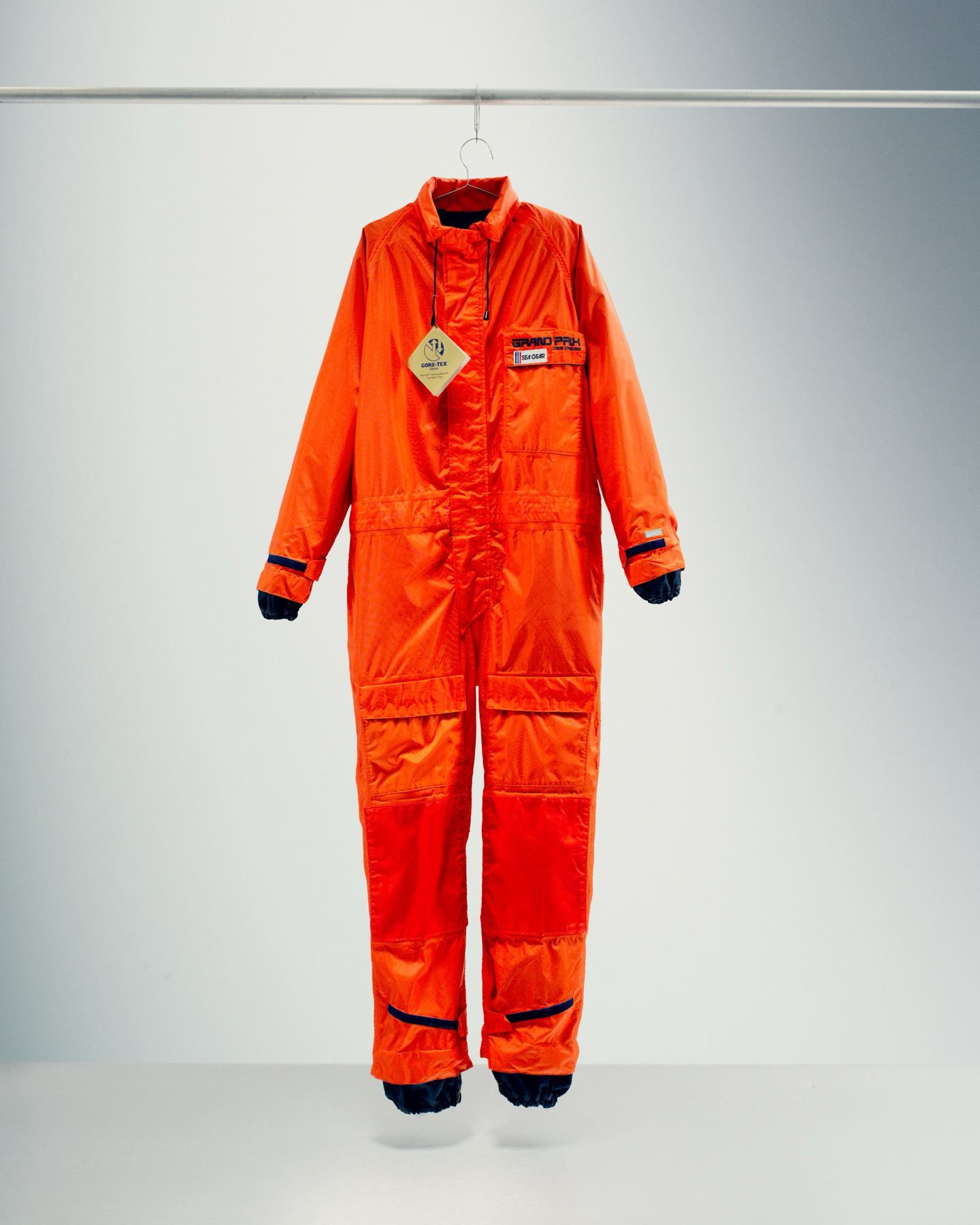
Messner and Habeler climb with a tent and a Millet jacket in GORE-TEX fabric. The same year, a suit for maritime use.
- 1979
Shoes, seams, firefighters
Brooks Hugger GTX, the first running shoe with the membrane. GORE-SEAM tape arrives. The first breathable barrier for firefighters.
- 1980
From the mountains to the city
Danner Light, the first waterproof GORE-TEX boot; Golo puts the membrane into high-heeled boots.
- 1983
Down to −40 °C
The US armed forces test GORE-TEX products in the ECWCS programme.
- 1987
The first Rain Room
A room that pours up to 56 centimetres of water an hour onto a garment.
- 1989
Guaranteed to Keep You Dry
The consumer guarantee: the product will be waterproof, windproof and breathable, or it will be repaired, replaced or refunded.
- 1992
Recycling, too soon
In Putzbrunn, a line breaks used jackets down into their original substances. It works, but there is no market.
- 1993
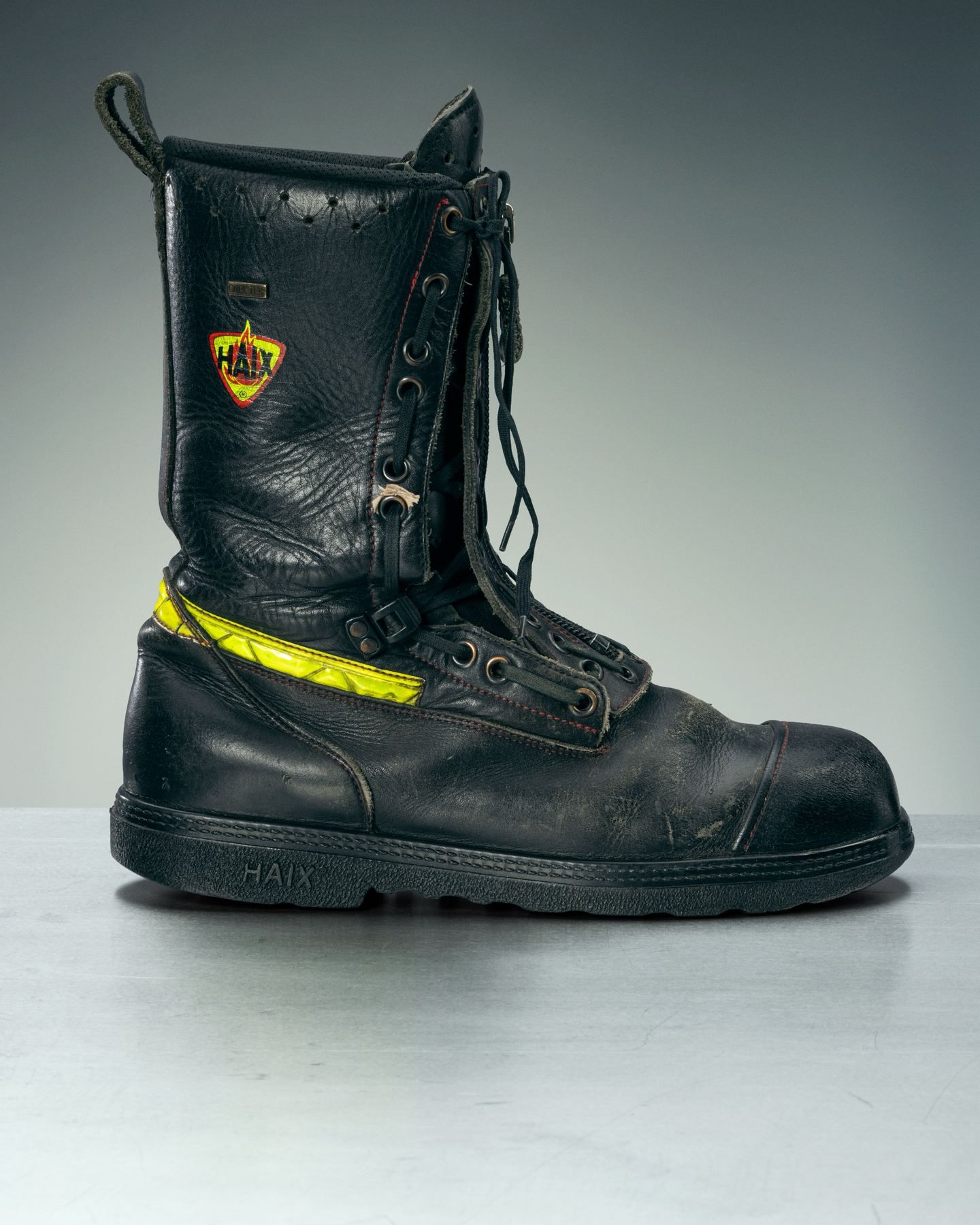
HAIX boots
The first leather firefighter boots with GORE-TEX technology.
- 1995
OEKO-TEX
Gore adopts OEKO-TEX® Standard 100 certification.
- 2000
AIRLOCK
More breathability and less weight in the thermal insulation layer of firefighter turnout gear.
- 2005
On the catwalk
Junya Watanabe of Comme des Garçons brings GORE-TEX garments to Paris Fashion Week.
- 2010
bluesign
Gore becomes a bluesign® system partner.
- 2011
PYRAD
Fabrics that char on contact with flame, for military personnel, rescue workers and technicians exposed to electric arcs.
- 2014
Trainers
ASICS GEL-Lyte V GTX, one of the first everyday trainers with the membrane.
- 2015
PARALLON
Two membranes, one on each side of the thermal insulation. Human rights guidelines are introduced too.
- 2018
6.4 seconds
The first collaboration with Supreme sells out. A new version of the CROSSTECH barrier.
- 2019
Climate targets
The first targets for all operations. Nike Air Force 1 GORE-TEX.
- 2021
EXTRAGUARD
The upper for safety footwear arrives in Europe. Zegna, La Sportiva and GORE-TEX on the catwalk.
- 2022
A change of material
The expanded polyethylene (ePE) membrane, made without intentionally added PFAS. Supply Chain Decarbonisation Project. Stretch CROSSTECH PYRAD.
- 2026
Fifty years
‘Going Further, Together’. HAIX presents the first firefighting boot with an EXTRAGUARD upper.
- 2030
The climate targets
Against 2016: −80% Scope 1 and 2 (target raised from 60%), −35% Scope 3, −40% overall.
- 2031
The last metre
By 31 March, Gore aims to ship the last metre of the old material in the professional and defence sectors too.
Rolls of laminate, services and a select few customers
Certified factories, services included in the price, more than 200 selected partners and a brand that acts as a guarantee for the consumer. The next steps: growth in defence and the switch of all production to the ePE membrane by 2031.
The GORE-TEX® brand’s largest consumer market is China. For a European reader, this may come as a surprise: how many Chinese brands using that membrane spring to mind? Probably very few. The explanation shows just how much the market has changed. Before the COVID-19 pandemic China was already growing, but work with local brands accounted for only a small share of the total. After the pandemic, Chinese consumers began to favour domestic brands, as has happened in many other industries, starting with cars. Today the largest local customer is Kailas, alongside brands such as Kolon Sport, which is of Korean origin. The market remains open to international brands, but the customer map looks very different.
It is a good starting point, because it shows that the GORE-TEX business model cannot be understood simply by looking at the swing tag hanging from a jacket or a shoe. Behind that tag lies a system of relationships, rules and services that explains both the brand’s strength and its choices, which sometimes go against the grain.
Few customers, a lot of control
- over200
selected partners, from Japan to the United States
- 13,000
associates at W. L. Gore & Associates (not employees)
- 5bn $
annual revenue of the whole company
- 1976
the start of the relationship with Marmot, the longest in outdoor
What you buy and what you get
Let’s start with what Gore physically sells: rolls. Customers buy the laminate – that is, the membrane already bonded to the fabrics, wound onto reels – along with the tape for sealing the seams and some supporting materials. If that were the end of the story, Gore would be just another materials supplier.
But it does not end there. Around those rolls the company has built what it calls an ecosystem, and to understand it, it helps to group its components into three families. The first is science: expertise in materials and ongoing, long-term research, because innovation, Gore points out, does not happen every season. The second is control: production only in certified factories, laboratory and field testing, and approval of individual models before they reach the market. If a brand wants to use a particular leather or fabric in a shoe, it can send it to Gore, which checks whether the material meets the required standards. The third family concerns the market: the GORE-TEX brand, marketing and data-driven consultancy. The example Gore gives is concrete: it knows the Chinese market inside out and can help a European brand that wants to enter it.
Gore sums all this up in a phrase, ‘more than a materials partner’. At the centre it places two pillars, the product and the brand, surrounded by the services that hold them up.
‘More than a materials partner’
The two pillars at the centre, the services that hold them up around them. Tap one of the three families.
Expertise in materials
Expertise in materials and ongoing, long-term research: innovation, Gore points out, does not happen every season.
Certified factories and approved models
Production only in certified factories, laboratory and field testing, approval of individual models before they reach the market. A brand can send in a leather or a fabric: Gore checks whether it meets the standards.
Brand, marketing, data
The GORE-TEX brand, marketing and data-driven consultancy. Gore’s example: it knows the Chinese market inside out and can help a European brand that wants to enter it.
The service is included – and mandatory
One aspect sets this model apart from that of an ordinary supplier. Customers pay for the product, not the services. Some services, however, they are obliged to accept. The membrane cannot be used in just any factory, nor can a model be brought to market without passing the checks. Inside the company they admit it with a certain candour: working with Gore can, at times, be a bit of a struggle. In return, they argue, you get a great deal; otherwise the company would not have been in business for fifty years.
The reason for such rigidity lies in the ‘Guaranteed to Keep You Dry’ promise, introduced in 1989 and applicable to consumer products. With it, Gore promises the consumer that the finished product will be waterproof, windproof and breathable. But the finished product bears another brand’s name and is made in a factory that does not belong to Gore. The only way to keep the promise is to control processes, seams and construction. In this sense the guarantee is not an accessory to the business model: it is its very heart. Everything else, from certified factories to model approval, serves to make it sustainable.
Few customers, by choice
This leads to the most counter-intuitive choice. Gore maintains that it could have three or four times as many customers as it does, but that it does not seek them out. The reasoning is this: the market can only absorb a certain amount of premium product. If new brands keep being added, they end up competing for the same consumers, and nobody gains, not even Gore. Better a stable portfolio built on long-lasting relationships. The longest-standing is with Marmot, which dates back to 1976.
Gore maintains that it could have three or four times as many customers as it does, but that it does not seek them out.
This does not mean that partners are few in absolute terms. There are more than 200, from Japan to Korea, from China to Europe and the United States, ranging from brands specialising in very specific niches to large global groups such as Nike and Adidas. Rather, it means that every new entry is assessed. The only stated exception concerns some young lifestyle brands, which help GORE-TEX reach a new audience. For those wishing to join, size is not the only criterion: being small in volume is different from being small in image. A young company with a strong design project may interest Gore more than a large but unremarkable brand, not least because Gore says it wants to learn from these brands how they communicate, how they manufacture and how they interpret design.
The visible ingredient
GORE-TEX is what marketing calls an ingredient brand, a brand that sits inside someone else’s product. Yet Gore considers itself a consumer brand in every respect, which explains the importance of the logo on the finished product. It often discusses this with partners, for example how visible the logo should be or whether it can be tone-on-tone, but Gore insists it is not a contractual obligation. The logo, it argues, benefits the partner first and foremost: it tells the consumer that the product has been tested and is covered by a guarantee, and so drives customers towards the brand selling it. In defence, where visibility is not an asset, the logo does not always appear.
The link to price is explicit. In the framework Gore uses to describe its value, premium positioning serves to support higher prices, justified by the trust consumers place in the brand. It is a line of reasoning that anyone working in footwear knows well: trust, once built, becomes a selling point.
The shoe as intellectual property
In footwear, the model gains an extra element. For a jacket, the laminate is a large part of the product. For a shoe it is not: a flat, two-dimensional material has to be turned into a three-dimensional object that stays waterproof at every point, including where the upper is folded, stitched and glued to the sole. According to Gore, the real differentiator in footwear lies in the construction technologies, which are usually patented. The shoe factory receives not just a laminate but a body of knowledge on how to make a shoe light, breathable and truly waterproof. This knowledge is passed on by Gore’s application engineers, who work with the partner brands’ designers and then in the factories when the model goes into production.
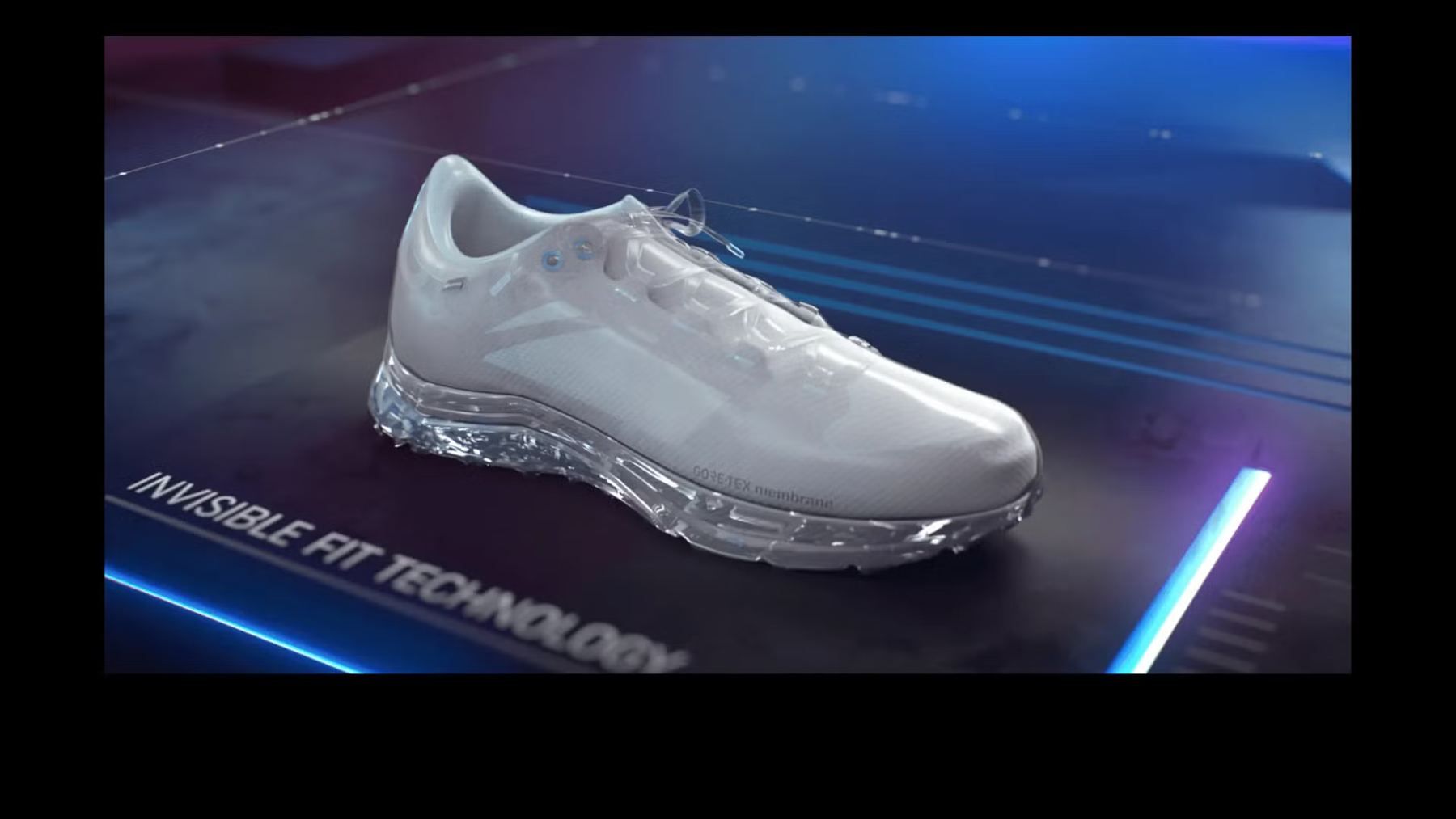
The strongest demand at the moment is for lightness. GORE-TEX Invisible Fit technology, in which the membrane is laminated directly to the upper, was developed for running, where every gram counts, and according to Gore the same concept could also reach safety footwear.
Consumer footwear remains rooted in outdoor, which still accounts for most of the business and gives the brand its credibility. But running is growing, on road and trail, and what Gore calls lifestyle is expanding. The term needs to be understood correctly: it does not mean fashion but shoes for an active everyday life. The 2026 selection shows this clearly, bringing together very different models such as the Clarks Wallabee GTX, the Nike Air Force 1 GTX, the New Balance 1906 GTX, the Salomon XT-6 GTX, a Regal loafer and a Paul Green Chelsea boot. Behind this variety lies a change in habits: the same consumer cycles, runs, goes to the office and travels, sometimes all in one day, and wants a shoe that keeps up in every situation.
Where the growth is
Today more than half of the business is consumer. Defence and safety carry roughly equal weight, but defence is growing, especially in Europe, where demand is significant. That is also where the main technical challenge of the coming years lies. The expanded polyethylene (ePE) membrane, introduced in 2022, is now used across the whole consumer range; it now has to be brought into professional and military applications too, where requirements are stricter and conversion is more complex. The deadline is set: by 31 March 2031, the end of the financial year, Gore aims to ship the last metre of the old material. The switch, the company says, has already begun.
On the brand side, the stated aim is to communicate the idea of safety more forcefully – that is, the confidence that the product will work – and to strengthen dialogue with consumer communities. On sustainability, Gore is experimenting with service-based business models and preparing for regulatory obligations, starting with the Digital product passportA digital record required by the new European ecodesign rules: it accompanies a product with data on materials, origin, repair and end of life.. Data, they point out, is already one of customers’ most frequent requests and will become an increasingly important part of the service.
In an industry that often measures success by counting customers, Gore also measures it by counting those it turns down.
Growth, then, but with substance, and only with partners able to take the brand a step further. The GORE-TEX model rests on a roll of laminate and everything around it: services that are not charged separately, factories that must be certified, and a guarantee that ties the material to the finished product and to the consumer. In an industry that often measures success by counting customers, Gore also measures it by counting those it turns down.
Emissions down 20 per cent as revenue grows
Since 2016 emissions have fallen from 212,000 to 171,000 tonnes of CO2 equivalent, while revenue has grown by more than 50 per cent. Still unresolved: the supply chain, recycling on an industrial scale and a durability that has yet to be measured.
At Glover Creek, Kentucky, almost 130 hectares of land are covered with solar panels. The plant has a capacity of 55 megawatts and will generate more than 110,000 megawatt-hours of renewable electricity a year. Gore does not own it, but will buy its entire output for twenty years, a commitment of more than 100 million dollars. It was that long-term contract that made building the solar farm possible: without a guaranteed buyer, the project would never have got off the ground. In return, the company can power all its operations in the eastern United States with renewable electricity and cut its carbon footprint by around 35,000 tonnes.
It is a good example of how Gore Fabrics, the division that makes GORE-TEX® fabrics, approaches sustainability: with measurable projects, published figures and a few caveats about their limits. Markus Wieser, who leads Gore’s carbon footprint and climate team, starts from a constraint. In Europe, the directive on empowering consumers for the green transition has recently come into force, requiring companies to be far more specific in their environmental claims. What does that change in practice? Generic slogans are no longer enough: clear figures, dates and boundaries are needed. That is also the right lens for reading Gore’s data.
A story that started early
The company’s environmental history began before sustainability became a market issue, and it includes an instructive episode. In 1992 Gore launched a textile-to-textile recycling process, with a production line at its plant in Putzbrunn, Germany. A used jacket went into the machine and was broken down into its original chemical substances. Technically it worked, but it was too early: nobody wanted those substances, there was no market for reusing them, and the process was halted. The initiative, called the GORE BALANCE PROJECT and run with several European brands, had nevertheless won the European Outdoor Award for Innovation in 1995. The lesson is that good technology, without an economic model to support it, does not last.
In the years that followed, progress came in more gradual steps. In 1995 Gore adopted OEKO-TEX® Standard 100 certification, which verifies that fabrics are free of harmful substances. In 2010 it became a system partner of bluesign®, the system that monitors how chemicals are managed along the supply chain. In 2015 it introduced its first comprehensive guidelines on human rights and social responsibility, applying to its own plants worldwide and also used in dealings with suppliers. In 2019 it set its first climate targets for all its operations.
Four priorities, one common framework
Today the strategy is called ‘Responsible Performance’. In a field that changes constantly, Wieser explains, the first rule is to focus. That is why Gore is investing in four areas, each with its own working group and its own targets: respect for human rights in its own plants and in the supply chain, reducing its carbon footprint, managing its chemical footprint, and the circular economy.
Beneath these four areas lies a common foundation that has become increasingly important in recent years: regulation and reporting, transparency and traceability, data and digitalisation. Gore has set up a team dedicated to tracking upcoming rules and to reporting. The volume of data collected, processed and shared with customers has grown exponentially. Wieser sees both sides: the data reveals far more than before about how a product is made and what it contains, but it is not always reliable or of good quality.
Four areas of work, one common foundation
Human rights in the plants and the supply chain
Carbon footprint
Chemical footprint
Circular economy
Regulation and reporting · transparency and traceability · data and digitalisation
The carbon figures
Understanding the climate targets requires a distinction. Scope 1, 2 and 3Categories of the GHG Protocol, the standard companies use to count their greenhouse gas emissions: direct (1), from purchased energy (2), and across the whole value chain (3). emissions are those linked to the energy a company uses in its own plants: the gas it burns and the electricity it buys. Scope 3 emissions are all the rest, and for Gore they mainly concern the energy suppliers use to make what goes into the laminates. They are the hardest to reduce, because they occur outside the company’s direct control.
Gore Fabrics’ targets take 2016 as the baseline and look ahead to 2030: a 60 per cent cut in Scope 1 and 2 emissions, 35 per cent in Scope 3 and 40 per cent overall. The first target has already been exceeded, and the company has raised the bar to 80 per cent.
Figures previewed from the Gore Fabrics Responsibility Update 2025 show the overall trajectory. In 2016 emissions stood at 212,000 tonnes of CO2 equivalent; in the 2026 financial year, which corresponds to calendar year 2025, they were 171,000. That is a reduction of around 20 per cent. Wieser urges caution in reading it: it could be 18 per cent, it could be 22, because measuring a carbon footprint is difficult. The figure that interests him most, however, is a different one. Over the same period revenue grew by more than 50 per cent. Emissions, then, fell while the business grew: this is what is known as decoupling. Here too there is a caveat: every year is a challenge in its own right, and the past does not automatically project onto the future.
Emissions down 20%, revenue up more than 50%
- −80%Scope 1 and 2 by 2030. Original target −60%, already exceeded.
- −35%Scope 3, supply chain emissions.
- −40%Total emissions against 2016.
 Watch the video
Part of the result comes from the plants. Emissions from purchased electricity have fallen to zero with the switch to 100 per cent renewable energy, achieved partly through contracts such as Glover Creek. At one site, a large boiler has been replaced by an electric steam generator. The recipe, Wieser sums up, applies to the whole technical apparel sector: switch to renewable electricity and cut energy use as fast as possible.
The heat in the supply chain
The biggest problem lies outside the factory gates. Of the 171,000 tonnes in 2025, 154,000 fall under Scope 3, the supply chain. To explain where these emissions arise, Wieser chooses a very concrete image: a huge dryer in a textile mill in Vietnam. Dyeing, applying chemicals and washing are all ‘wet’ processes, and whatever gets wet then has to be dried with heat. The decisive question is where that heat comes from: coal, gas, fuel oil or electricity.
That is why Gore talks to its suppliers every week about their energy consumption and sources, and looks for ways to help them switch to renewables. It is not equally possible everywhere. In Europe and parts of the United States the path is relatively straightforward; in Taiwan, where renewables supply around 10 per cent of electricity, it is much harder. That is also why, in 2022, Gore Fabrics was one of the initiators of the Supply Chain Decarbonisation Project, which brings together 10 brands with shared suppliers in the European Union: if several customers ask the same supplier for the same thing, the request carries more weight and gets results.
Recycling, but for what?
On the circular economy, Wieser starts with a question he often puts to the people he talks to: to do what? Circularity is not a goal in itself. It can help cut emissions, waste or the use of virgin resources, but you need to know which of these outcomes you are after. And it has to stand up economically; otherwise, as 1992 showed, it does not last. Of the many possible routes, Gore has chosen three: recycling, repair and care, and durability.
With recycling, the starting point is the make-up of the laminate. Most of the laminate’s weight lies in the fabrics, and that is where recycling makes the difference. Gore has used recycled fabrics since the early 2000s and has increased their share over time: today 78 per cent of consumer garments contain a recycled component, while in footwear the figure is 35 per cent. The latest development is textile-to-textile recycled face fabrics, made from old garments. Recycled polyester usually comes from plastic bottles, in other words from another sector’s waste. According to Gore, the technology to recycle a technical garment is now well advanced; the real problem is scaling it up industrially, finding the billions of investment Europe needs to close the loop. Another example is BIONIC® fabric, made of 50 per cent plastic collected from the coastline of the Nicoya Peninsula in Costa Rica and laminated to the new expanded polyethylene (ePE) membrane, which contains no intentionally added PFAS.
How many products have a recycled component
- 78%
of consumer garments
- 35%
of footwear
Wash the jacket (yes, wash it)
The second lever is care, and this is where most misconceptions circulate. Many people think that a GORE-TEX garment, given what it costs, should never be washed. That is wrong; in fact it is the surest way to ruin it. The garment goes in the washing machine, on a normal 30 or 40 degree cycle with almost any detergent. The only product to avoid is fabric softener, which impairs the performance of technical garments. After washing, dry it, on the line or in a tumble dryer, then see to the durable water-repellent finish, the DWR. If it still works, 30–45 minutes in the tumble dryer on a gentle heat is enough to reactivate it; if that is not enough, reapply it with a dedicated product, avoiding waxes and greases.
How to wash a GORE-TEX jacket
Machine wash, 30 or 40 degrees
Normal cycle, with almost any detergent.
No fabric softener
It is the only product to avoid: it impairs the performance of technical garments.
Dry
On the line or in the tumble dryer.
Reactivate the DWR
30–45 minutes in the tumble dryer on a gentle heat. If that is not enough, reapply with a dedicated product, without waxes or greases.
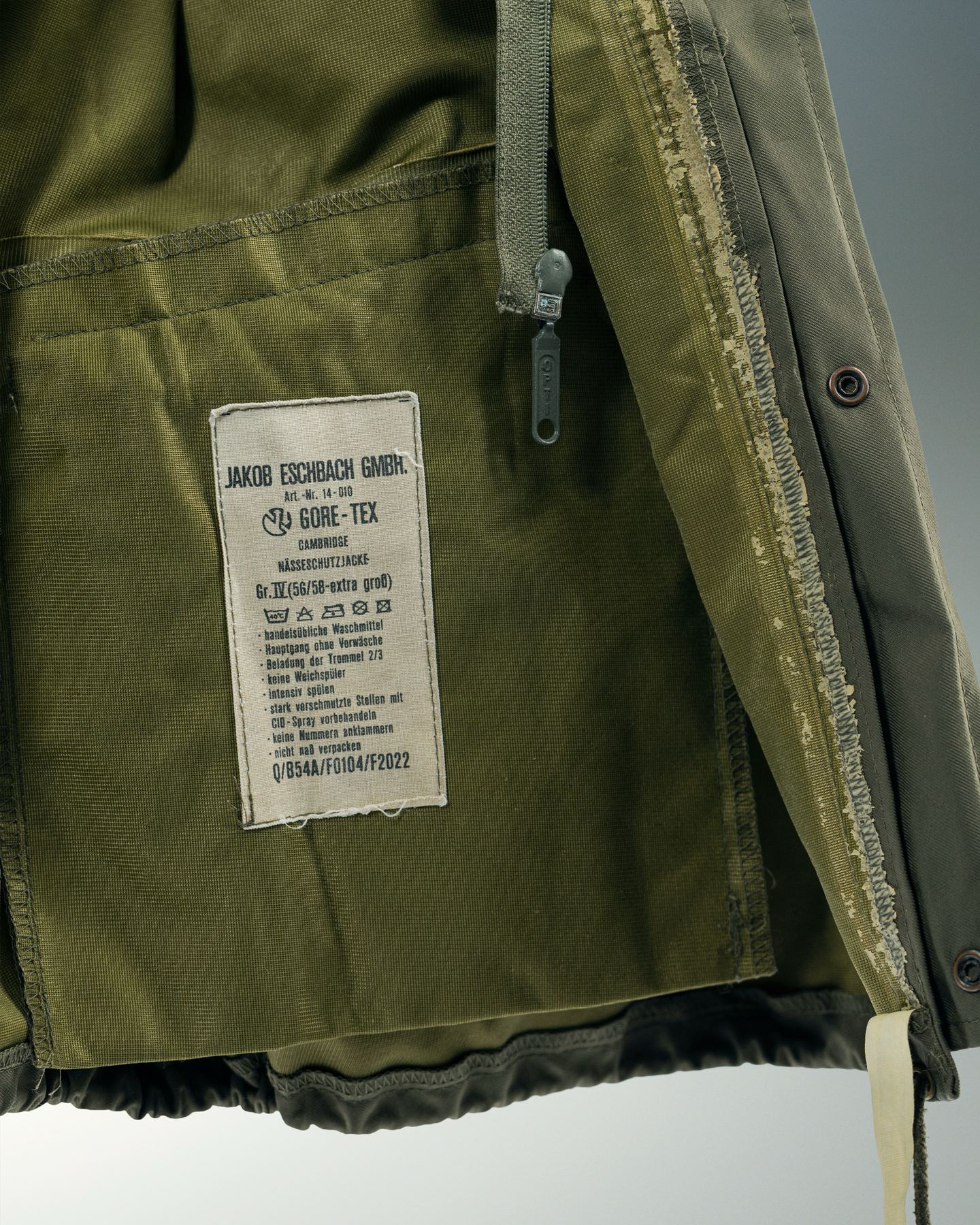
Why insist so much? Because when a garment comes back to customer service, Wieser explains, it is immediately clear whether it has been looked after. If it is not washed, sweat attacks the adhesive on the tapes that seal the seams, and the tapes come away. When a repair is needed, there are 45 certified centres in Europe, with machinery and staff trained to work on the garments.
Durability, measured
The third lever, durability, is the one Gore considers closest to its own history. The numbers explain why. In the United States each person produces on average around 100 pounds, almost 50 kilograms, of textile waste a year. Over fifteen years the number of garments owned has risen by 60 per cent, while each garment is worn half as often. Wearing a garment twice as long before throwing it away cuts its climate impact almost in half. Durability, then, is also an environmental strategy. And Gore’s market research shows that lasting performance is one of the main reasons consumers choose GORE-TEX.
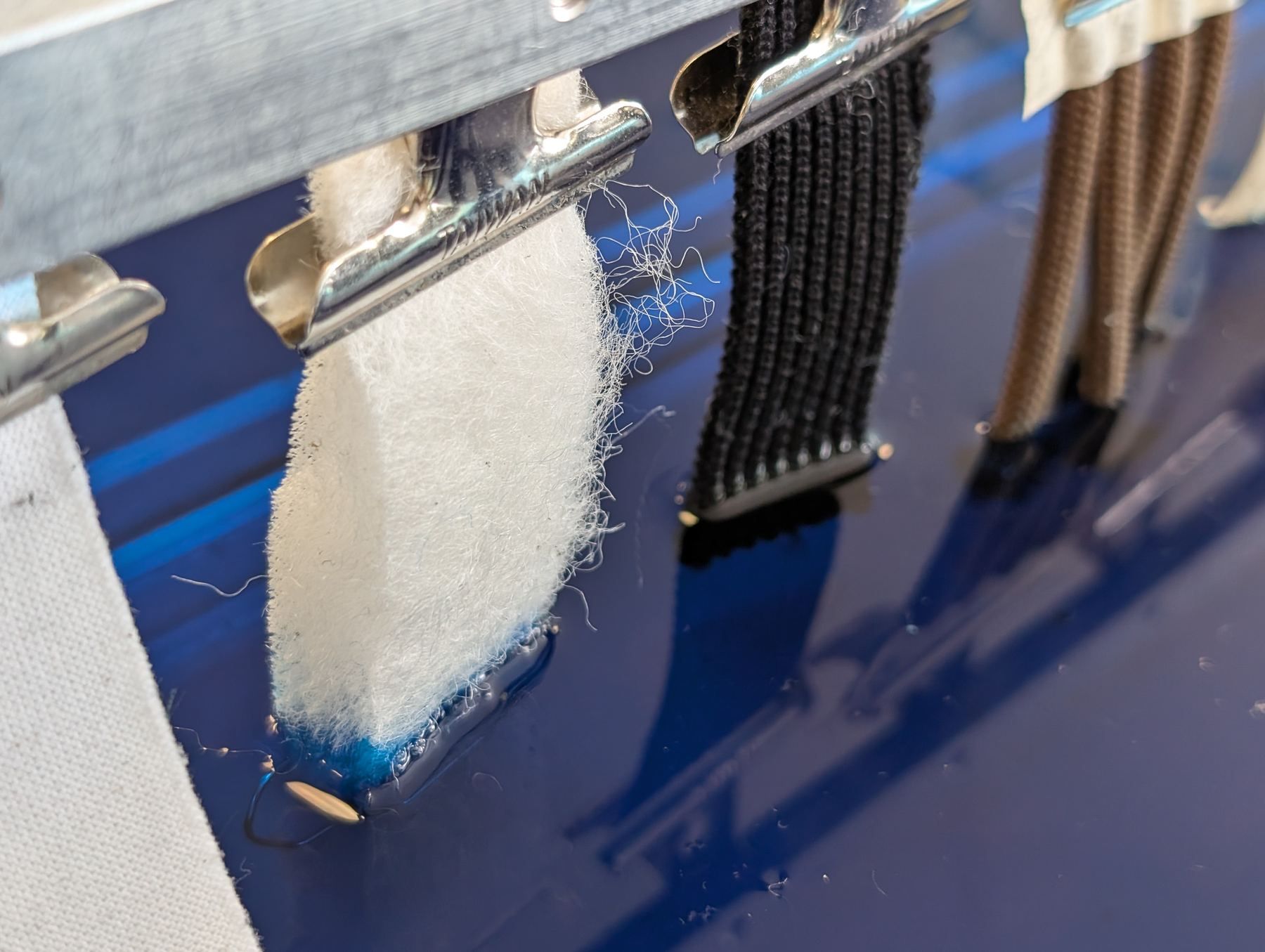
One problem remains, though: how do you measure durability? Gore has its own test protocols, but there is no method shared across the industry that works for different technologies and processes. That is why it has launched a project with the Sports Tech Research Centre at Mid Sweden University, involving more than 45 industry partners. The researchers examined hundreds of jackets and drew some conclusions. Construction matters a great deal: the oldest garments still working are those built robustly. Well-maintained middle-aged garments show no major damage. When a garment truly reaches the end of its life, however, all its components give way at once, from the zip to the bonding between the layers. And above all, you cannot tell from its appearance how durable a garment still is: a jacket that looks new may have the same defects as a worn one.
The Glover Creek solar farm and the washing machine at home seem worlds apart, but they lie on the same line. Gore’s sustainability is measured in megawatts and tonnes of CO2, and depends on suppliers thousands of kilometres away; but it is also measured in the years a jacket stays in the wardrobe and keeps doing its job.
In the mountains, footwear has been reinvented. In the fire station, far less so.
Moisture barriers and the EXTRAGUARD upper
CROSSTECH barriers, the PARALLON system and PYRAD fabrics that char on contact with flame: GORE-TEX technologies for people whose work puts them at risk. Firefighting boots see the debut of the EXTRAGUARD upper, 40 per cent lighter than leather.
Five firefighters stand in a row in front of a brick fire station, each wearing the uniform of a different era. The helmets change shape; the jackets move from black wool to technical materials with reflective strips. The boots, however, look almost the same. Gore pairs this image with a blunt headline: ‘The evolution of firefighting boots: few changes over decades’. And to make the contrast even sharper, it sets them beside mountaineering boots, from the old leather model with worn laces to today’s technical boots by La Sportiva and Scarpa. In the mountains, footwear has been reinvented. In the fire station, far less so.
Why? The answer leads into a world that, for GORE-TEX®, is a territory of its own, with rules different from those of the consumer market: the world of professionals who work exposed to risk.
No choice
The difference becomes clear if we start from a common experience. When a hiking jacket fails, it is an inconvenience: you get annoyed, perhaps after paying a lot for it, and next time you choose a different one. For a professional it is different. Their safety, sometimes their life, may depend on their kit. They cannot go back for an extra layer. And often they do not even choose what to wear, because someone else buys it for them.
Gore divides this world into two large blocks. The first is safety, which covers very different groups: postal workers, railway workers, forestry workers, power line technicians repairing the lines after a storm; then firefighters, technical rescue teams and paramedics; and finally the police, including riot units. The second block is defence, with foul-weather clothing systems designed for temperatures from −50 to +50 °C and garments that protect against flame.
These workers have two things in common. They are exposed to serious risks, and they wear their garments for many hours: eight, nine, ten a day. A railway worker inspecting the tracks walks 13–14 kilometres in a shift, often in weather that changes from sun to rain. That is why protection alone is not enough: it works rather like an airbag, which you hope never to have to test to the full, whereas comfort is felt every minute and decides whether the garment will actually be worn. Gore calls its method ‘fitness-for-use analysis’: it looks not only at the risk to be protected against, but also at how the garment is used, how long it has to last and even how it is washed.
A multi-layer sandwich
To understand what Gore does in firefighting clothing, you have to take a garment apart. In a hiking jacket, the GORE-TEX laminate is almost the whole garment. In a firefighter’s turnout gear, by contrast, it is one layer in a sandwich. On the outside is a flame-resistant fabric. Beneath it is the moisture barrier, which is Gore’s contribution. Further in is the thermal liner, which insulates against heat. The three layers work together: heat comes from outside and the gear has to slow it down, while the moisture produced by the body has to find a way out.
The moisture barrier has a dual task. It has to stop firefighting water and scalding steam getting in, and at the same time let sweat out. The reason is physical, and less intuitive than it seems. Water conducts heat 23 times faster than dry air, and air saturated with moisture holds far more energy than dry air. A wet uniform, whether wet from outside or inside, therefore transfers heat to the body much faster. Many burns, Gore’s engineers explain, are caused not by flames but by water and steam. It is the same phenomenon that makes 30 degrees in a tropical climate feel hotter than 30 degrees in the desert. The principle also applies, in reverse, to a soldier in the Arctic: in both cases moisture has to get out of the body and must never get in.
Heat comes in, sweat has to get out
Standard operations, with air up to 300 °C.
Then there is an aspect that concerns the head, not just the skin. When body temperature rises, the ability to concentrate drops, and with concentration goes safety. A uniform that keeps the firefighter cooler and drier lets them work longer and stay clear-headed. The conditions vary enormously: from routine operations, between 10 and 60 °C, to standard operations, with air up to 300 °C, to emergencies, where temperatures reach 1,000 °C.
- Routine10–60 °Croutine operations
- Standard300 °Cair in standard operations
- Emergency1,000 °Cin emergencies
CROSSTECH, AIRLOCK, PARALLON
Gore has been working on this problem for almost fifty years. In 1979 it introduced the first breathable moisture barrier for firefighting clothing; in 1981 Globe became its first customer in the United States. Since then the barrier has evolved in several directions, and it is worth telling them apart.
The first direction is protection against biological and chemical hazards. Firefighters, paramedics and rescue teams often come into contact with blood and bodily fluids, or with substances such as fuels and acids, for example at road traffic accidents. GORE® CROSSTECH® technology meets this need. In its 2018 version, the GORE-TEX barrier with CROSSTECH technology combines durable waterproofness with protection against blood-borne pathogens and common chemicals such as battery acid and hydraulic fluid. It remains breathable and keeps its performance even after many washes.
The second direction is lightness. In 2000 Gore introduced GORE-TEX AIRLOCK, a technology that increases breathability and reduces the weight of the thermal insulation layer. It can be combined with the CROSSTECH barrier.
The third direction addresses a specific problem: thermal insulation soaked with sweat insulates far less. The GORE-TEX CROSSTECH PARALLON system, launched in 2015 as GORE PARALLON, tackles it by placing two membranes, one on each side of the insulation. One keeps out water coming from outside, the other protects the insulation from sweat coming from the body. So thermal protection does not collapse when the uniform gets wet. In a testimonial video, the in-house fire brigade of a large German shipyard describe spending 30–45 minutes inside a heated container and choosing CROSSTECH PARALLON after lengthy trials, for its short drying and cooling times.
PYRAD, the flame that becomes a shield
Not every call-out involves a fire. In technical rescue, at a road traffic accident for example, flames are occasional, perhaps just sparks, but agility and freedom of movement are needed to work among twisted metal, on rocks or in floodwater. For these situations Gore uses PYRAD®, a technology introduced in 2011 and on the market for around fifteen years.
PYRAD works differently from traditional flame-retardant fabrics. It is neither a chemical treatment nor a surface coating: it is a technology intrinsic to the fabric, so it stays effective for the whole life of the product. When the fabric is hit by a sudden flash of flame, it forms a stable charred barrier that limits the heat reaching the skin. The same happens in arc-flash fabrics when they are exposed to the heat of an explosion. PYRAD is combined with textiles such as nylon or polyester and provides light, self-extinguishing protection while retaining abrasion resistance, colourfastness and printability.
Its applications have grown with the needs of those who use it. Around ten years ago came the first large contracts and the power line technicians, exposed to Electric arcAn electrical discharge that crosses the air between two conductors. In a fraction of a second it releases intense heat and light. exceeding 1,000 degrees: in this case the jacket reacts only on the outside, while the inside stays intact. Then came technical rescue. In 2022 Gore launched the stretch fabric GORE-TEX CROSSTECH PYRAD, which combines flame protection with chemical resistance and protection against viral and blood-borne pathogens. PYRAD also protects riot units, such as those of the German Federal Police, who spend hours guarding international summits or major matches, situations that can suddenly turn ugly.
PYRAD is not there to let you walk into a fire, but to buy the few seconds needed to get out.
In defence, attention to flame grew after the war in Afghanistan, when soldiers from NATO countries found themselves exposed to sudden flashes of flame as they got out of armoured vehicles. Here the objective needs to be clear: PYRAD is not there to let you walk into a fire, but to buy the few seconds needed to get out. It is found in everyday wear, including versions without a membrane, and in foul-weather garments for ship and helicopter crews.
Here too, comfort weighs as much as protection. A version used in the field for around fifteen years works well below 20 °C, but above 25–30 degrees it becomes uncomfortable, and soldiers tend not to wear an uncomfortable garment. Hence the latest development, launched last year: a membrane-free PYRAD laminate, highly breathable and stretchy, designed for hot climates. The same reasoning applies to electricians in summer. If the protective garment is heavy, the first thing they do is open the zip to get some air, and that is exactly when an electric arc can strike. For them there is a light, membrane-free, high-visibility version.
The main obstacle, however, is not technical but cultural. Soldiers and workers have been trained for years to believe that heavy means protected. Convincing them that a light garment protects them just as well takes time: wear trials lasting weeks or months with groups of users, and the go-ahead from procurement agencies, which choose for thousands of people and, understandably, do not want to take risks.
Technologies for people who work at risk
A barrier against water, blood and chemicals
Combines durable waterproofness with protection against blood-borne pathogens and substances such as battery acid and hydraulic fluid. Stays breathable even after many washes.
Lighter, more breathable insulation
Increases breathability and reduces the weight of the thermal insulation layer. Can be combined with the CROSSTECH barrier.
Two membranes either side of the insulation
One keeps out external water, the other protects the insulation from sweat. Thermal protection does not collapse when the uniform gets wet.
The fabric that chars
A technology intrinsic to the fabric: on contact with flame it forms a stable charred barrier. Since 2022 also in stretch form (CROSSTECH PYRAD) and, for a year now, without a membrane for hot climates.
The upper that doesn’t soak up water
40% lighter than full-grain leather when dry, stays light when wet, dries quickly and cleans under the tap.
A boot that stays light even when wet
Back to the boots we started with. In 1993 HAIX launched the first leather firefighter boots with GORE-TEX technology, waterproof and breathable. Leather has remained the benchmark ever since, for good reasons: it is tough and proven. But it has a limitation. Unless it is greased regularly it absorbs water, and a firefighter works almost constantly surrounded by firefighting water. Today, Gore’s engineers observe, hardly anyone greases their boots regularly any more. The result is a boot that gets heavy, gets cold and dries slowly, and may have to be pulled on again the next day for another call-out. Cold, damp feet mean discomfort, and discomfort weighs on concentration.
Weight, too, matters more than you might think. Engineers often quote a rule: one gram on the foot is worth five grams on the back. And a firefighter already carries 25–30 kilos of equipment.
One gram on the foot is worth five grams on the back
Bar: compared against 6 kg. A firefighter already carries 25–30 kilos of equipment. The rule is the one quoted by Gore’s engineers, not a measurement.
Gore’s answer is the GORE-TEX EXTRAGUARD upper, launched in Europe in 2021 for safety footwear and now also in firefighting boots. It is a technical material designed to combine the advantages of leather with those of textile uppers. When dry it is 40 per cent lighter than full-grain leather, and above all it stays light even when wet, because it absorbs very little water. It dries quickly and loses less heat when wet. It protects against abrasion, common chemicals, moisture, sharp objects and falling objects. It needs no maintenance: it can be cleaned under the tap or with a hose, without any special products.
HAIX, one of Gore’s main footwear partners, presented the first firefighting boot with an EXTRAGUARD upper this year.
Full-grain leather and EXTRAGUARD
- Full-grain leather
- EXTRAGUARD
Relative weight, leather = 100. When wet the gap widens, because EXTRAGUARD absorbs very little water; Gore gives no figure.
Standards written for yesterday
One last obstacle remains, perhaps the slowest to overcome: technical standards. They are often written around the technologies that existed when they were drafted. On some requirements, such as flame resistance, there is no debate and no compromise. On others the problem is subtler. A lighter laminate may improve breathability yet fall short of a tear strength designed for heavier materials; in that case the product is not certified and the contract falls through, even though in real use that requirement might matter less.
To explain this, Gore uses an analogy from cycling. Thirty years ago the Union Cycliste Internationale (UCI) set the minimum weight of a racing bike at 6.8 kilos. It was not a whim but a safety decision: with the materials of the day, a lighter bike risked being fragile. Today materials and construction methods have changed, and the rule is being debated again. The same goes for standards on protective equipment: you have to understand the original intent of a requirement and show that a new technology meets it, perhaps in a different way.
This is also why firefighters’ boots have stayed almost the same for decades. Changing them means convincing those who wear them, those who buy them and those who write the rules. It is slower work than any patent, and it runs through the physics of steam, wear trials lasting months and a material that stays light even when wet.
Three days with GORE-TEX
 Watch the video
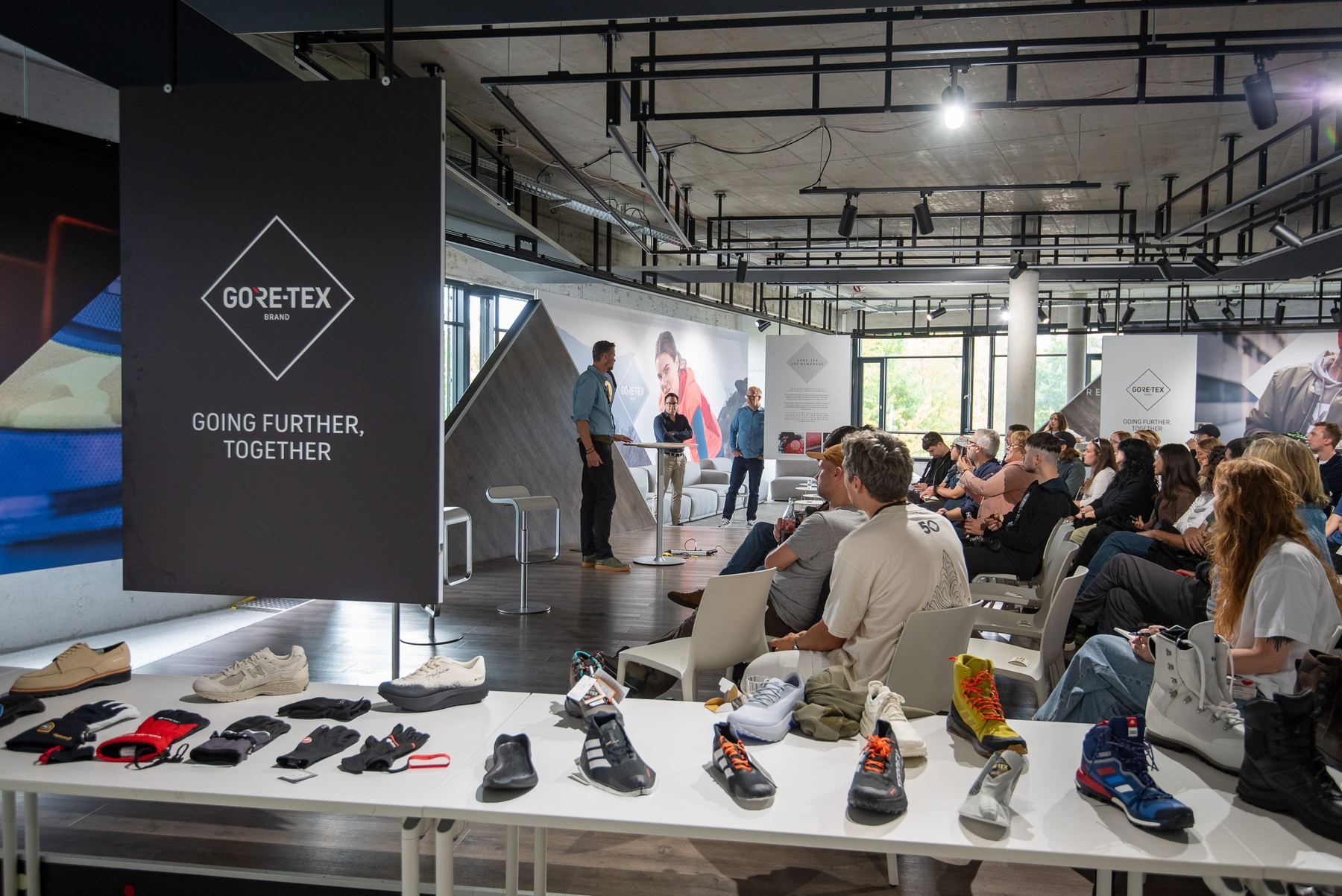
01 / 18The fiftieth-anniversary event room, with the footwear selection. 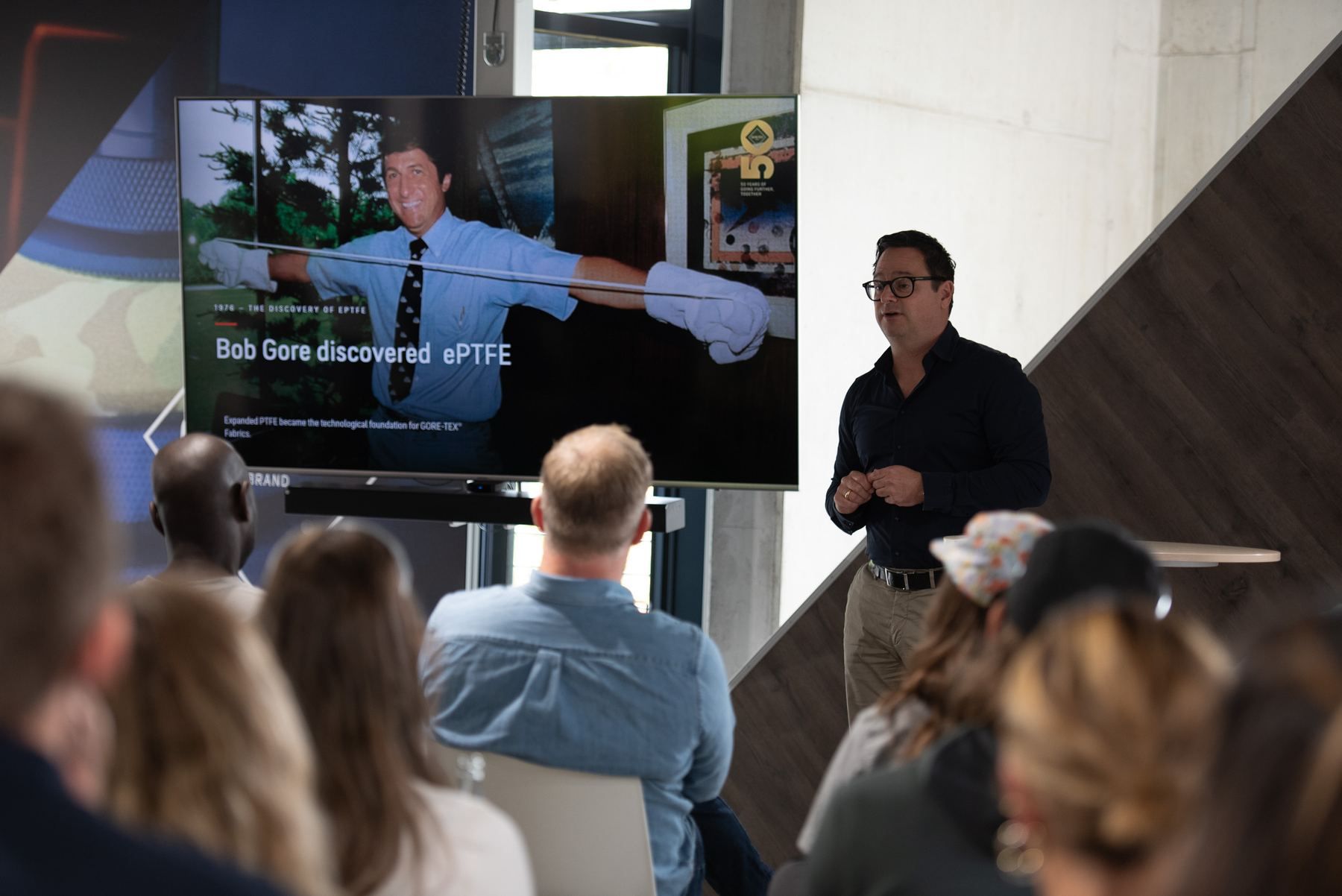
02 / 18The presentation on the brand’s history: Bob Gore and expanded PTFE on screen. 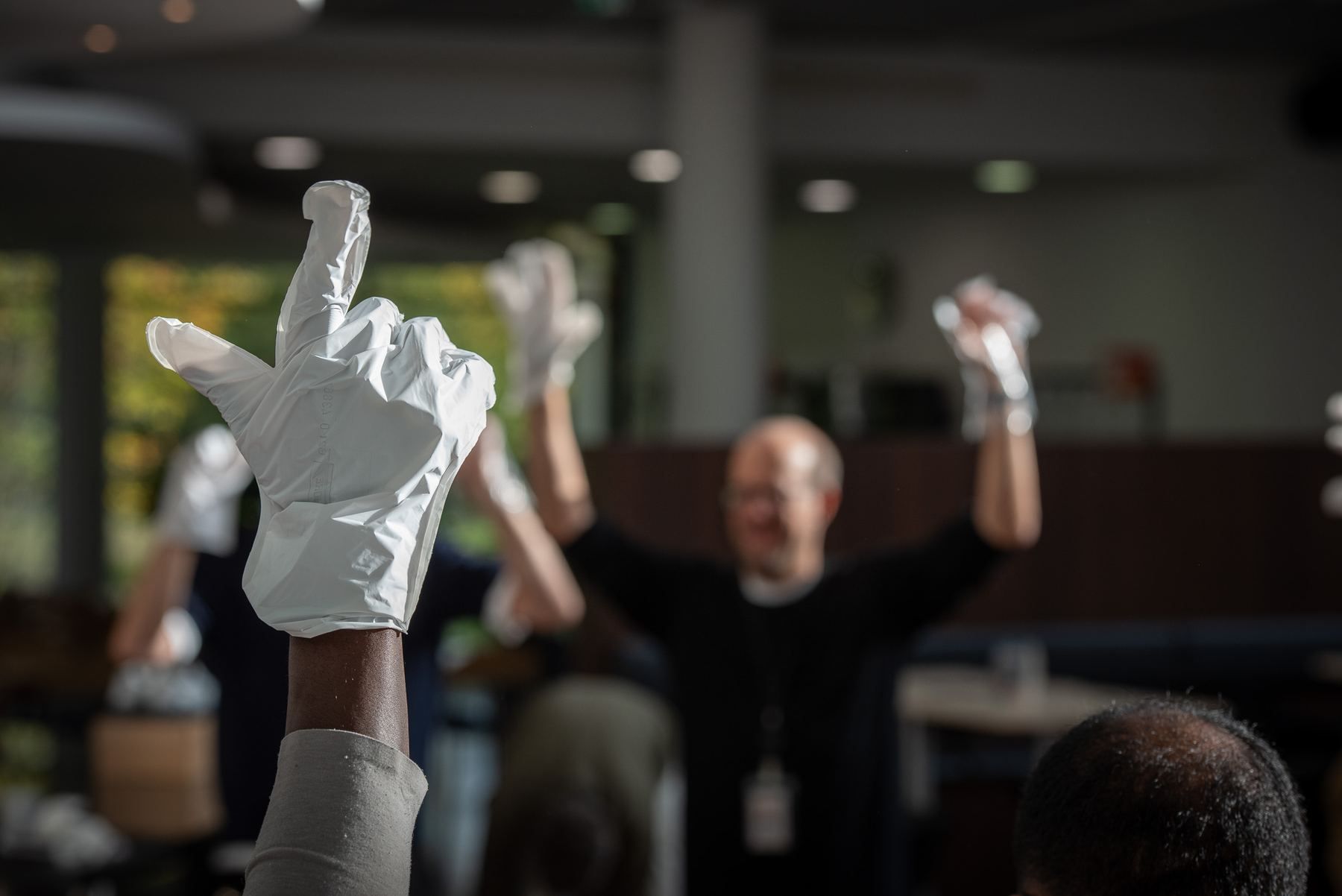
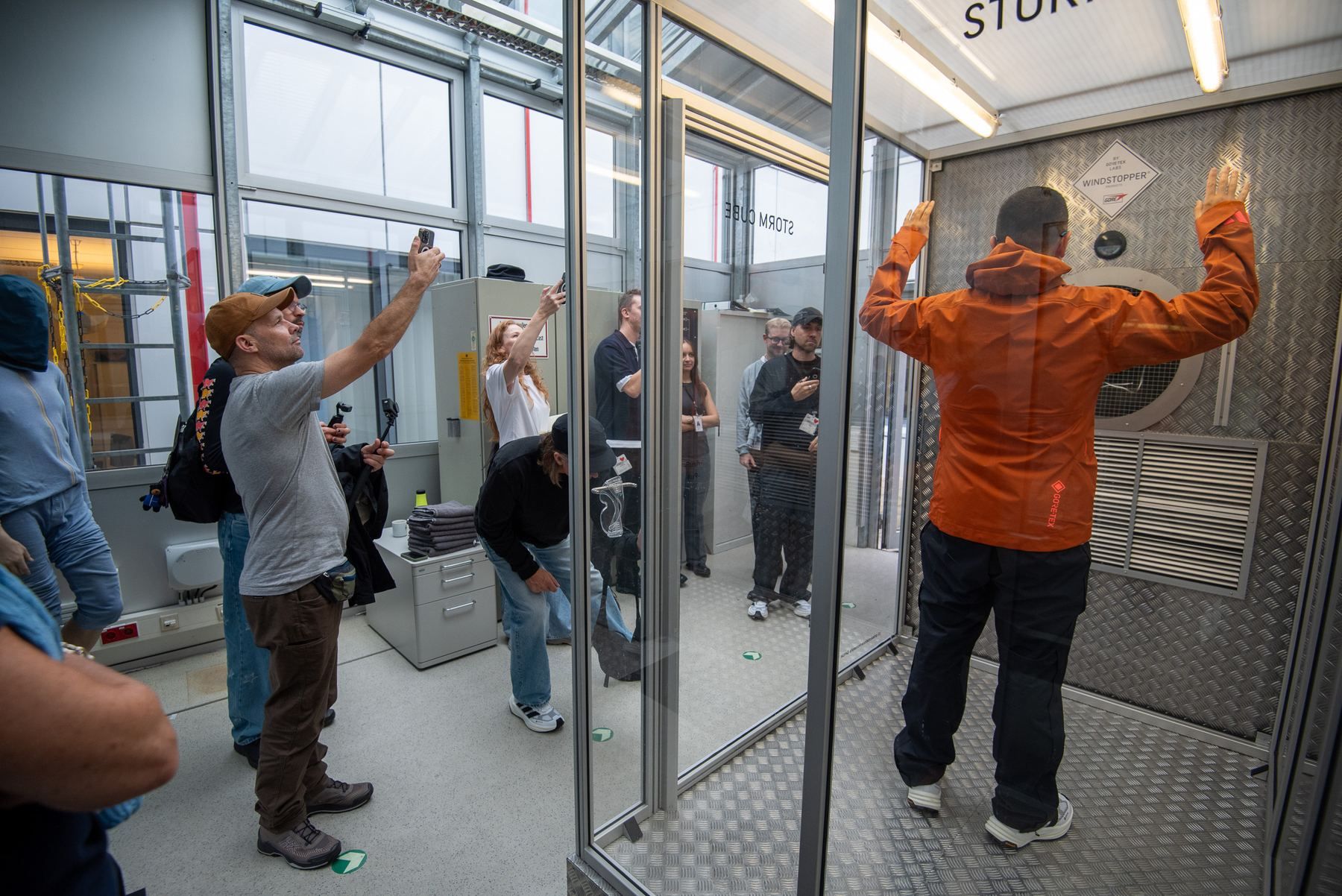
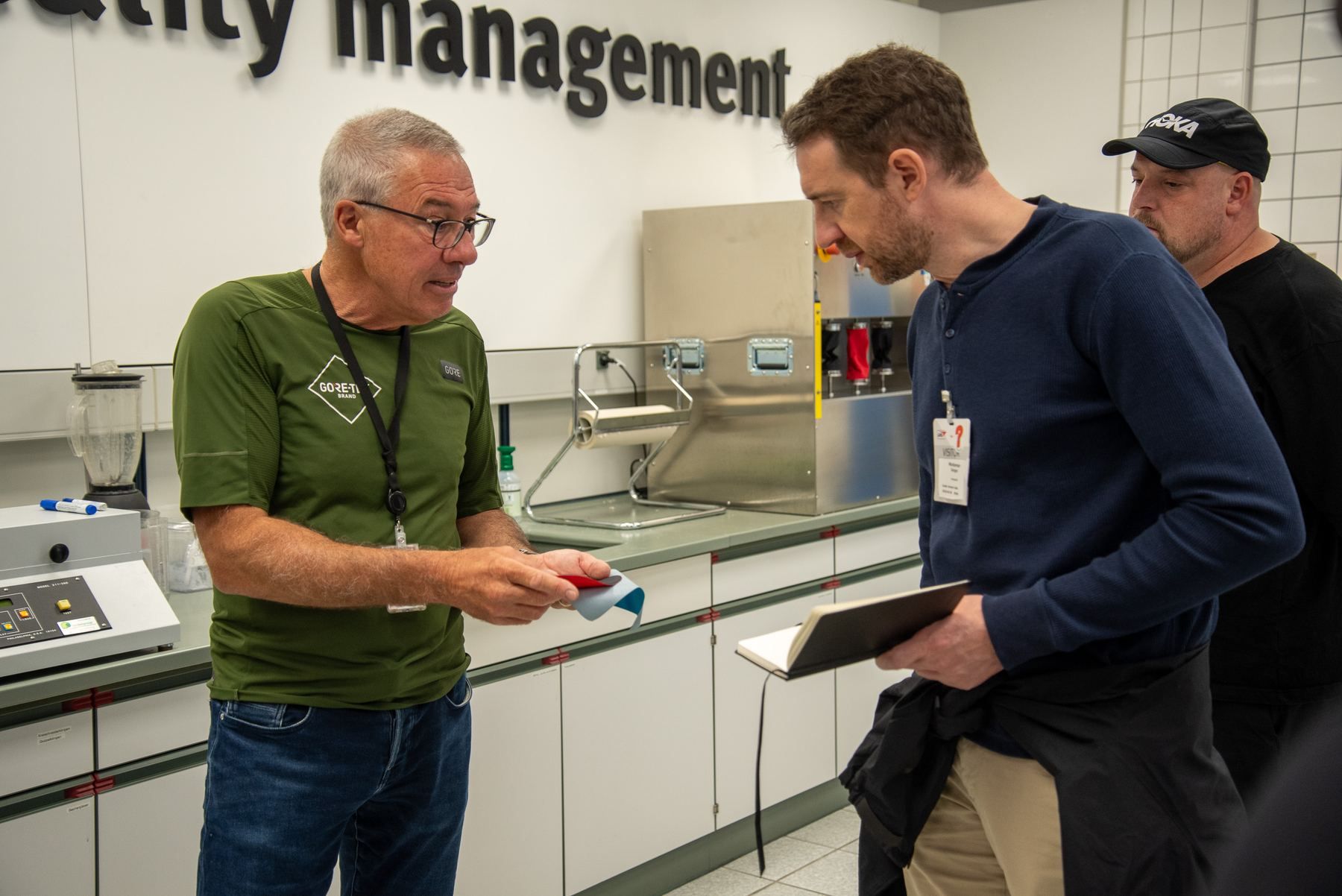
03 / 18The breathability test: one hand covered in plastic, the other in GORE-TEX. As the hands open and close, the first sweats, the second stays almost dry. 04 / 18In the quality-control laboratory. 05 / 18The test that measures how much water different materials absorb. 06 / 18The Storm Cube: a garment under simulated wind and rain. 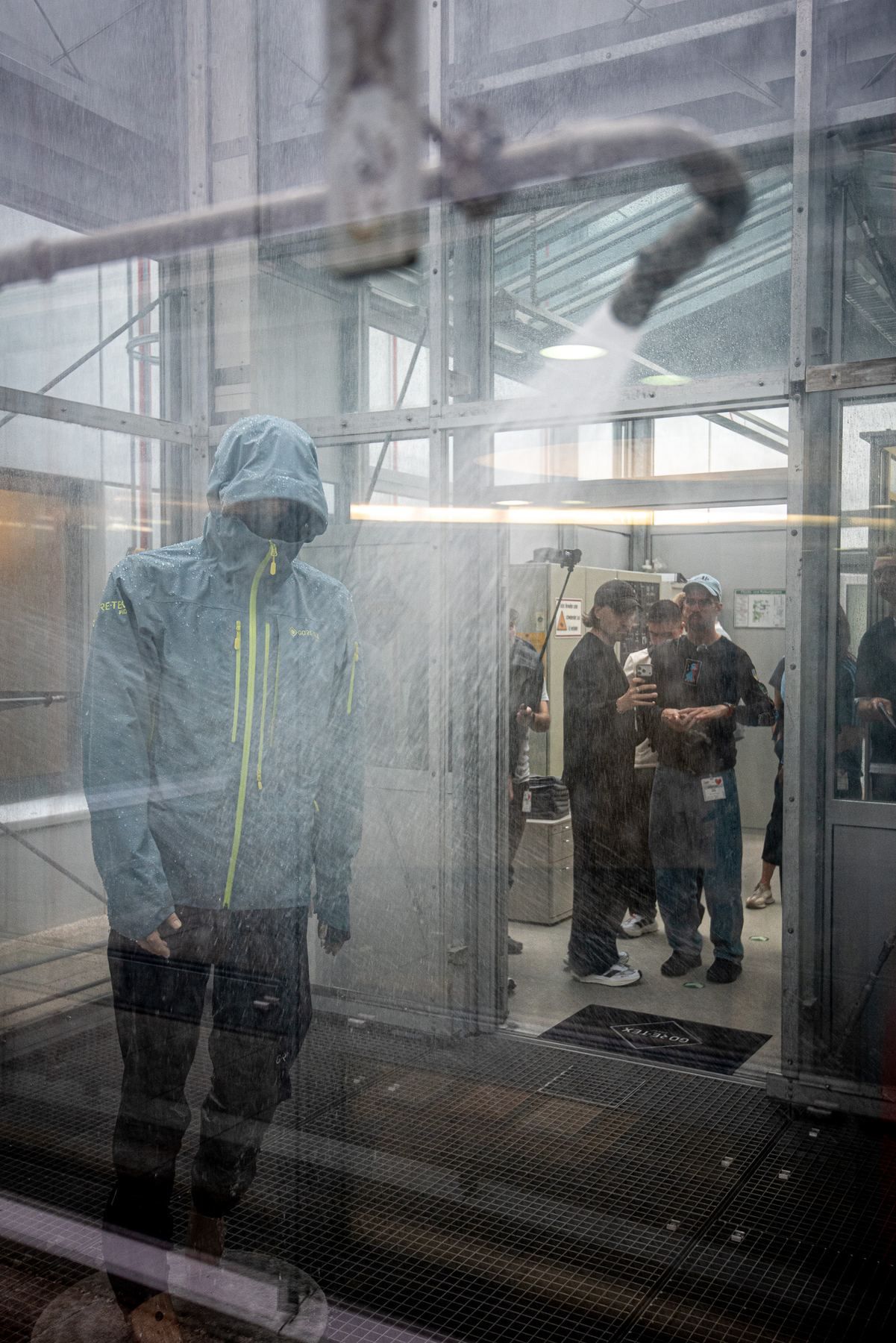
07 / 18Inside the Rain Tower. 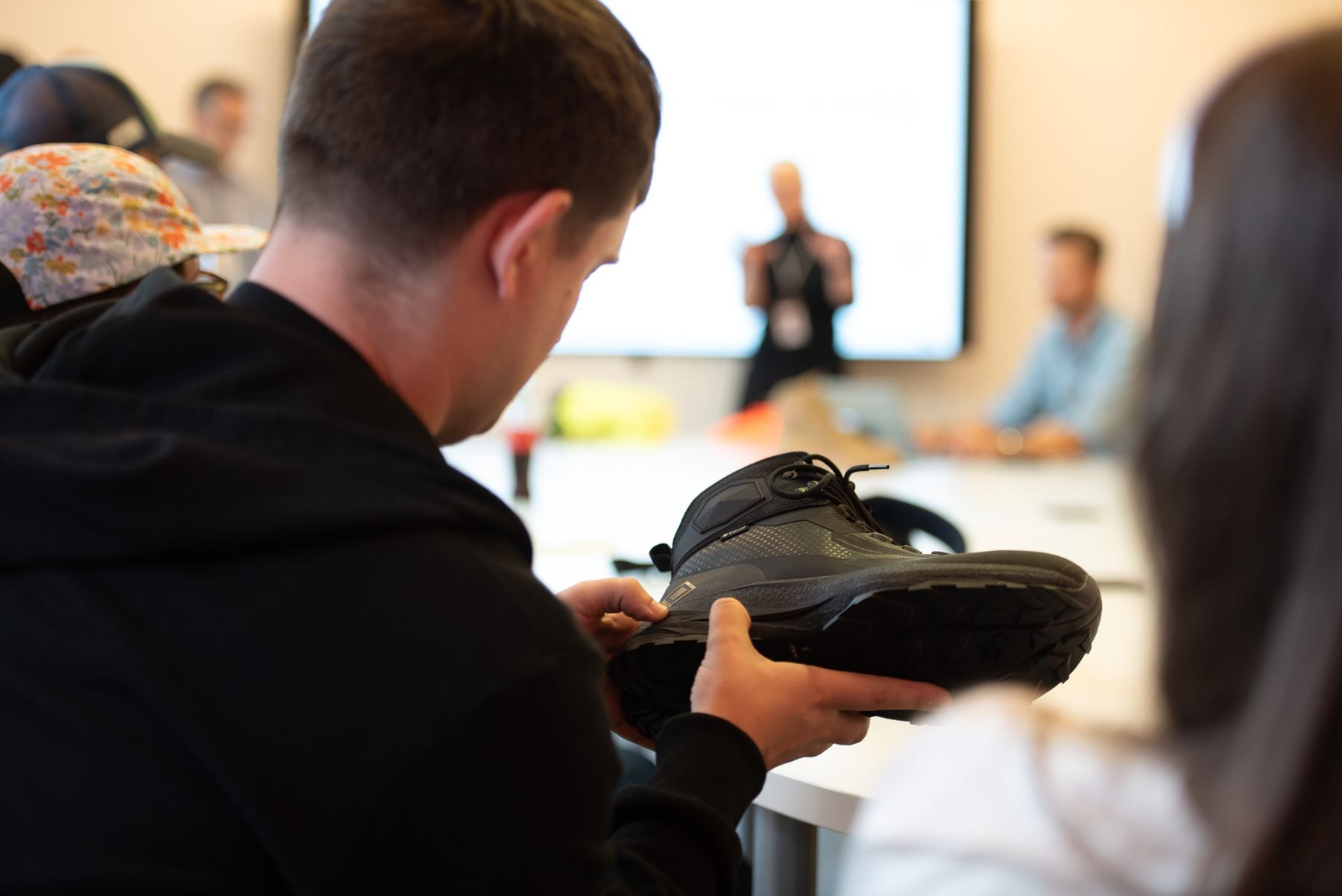
08 / 18A shoe passed from hand to hand during the presentation. 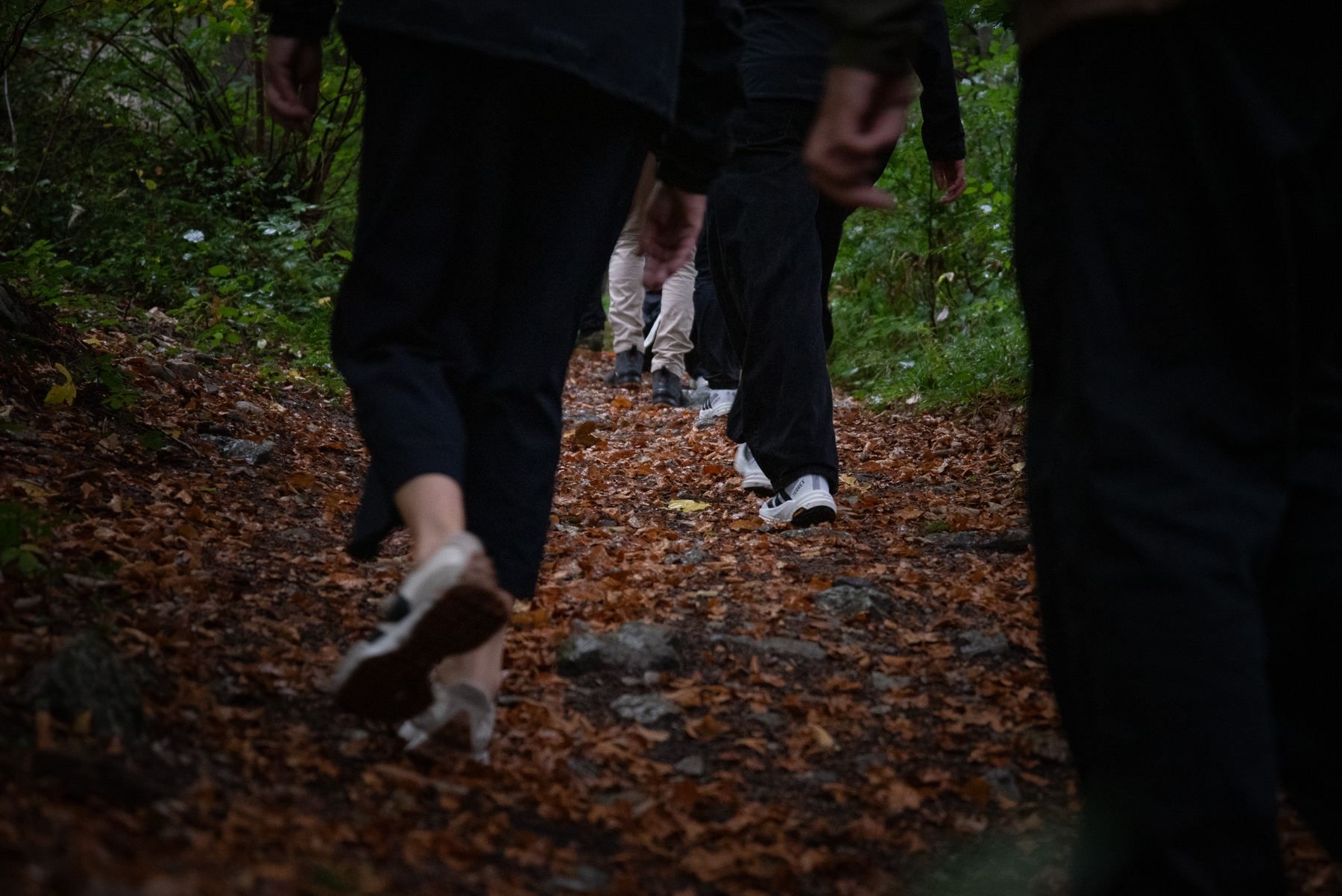
09 / 18The hike: the woodland trail. 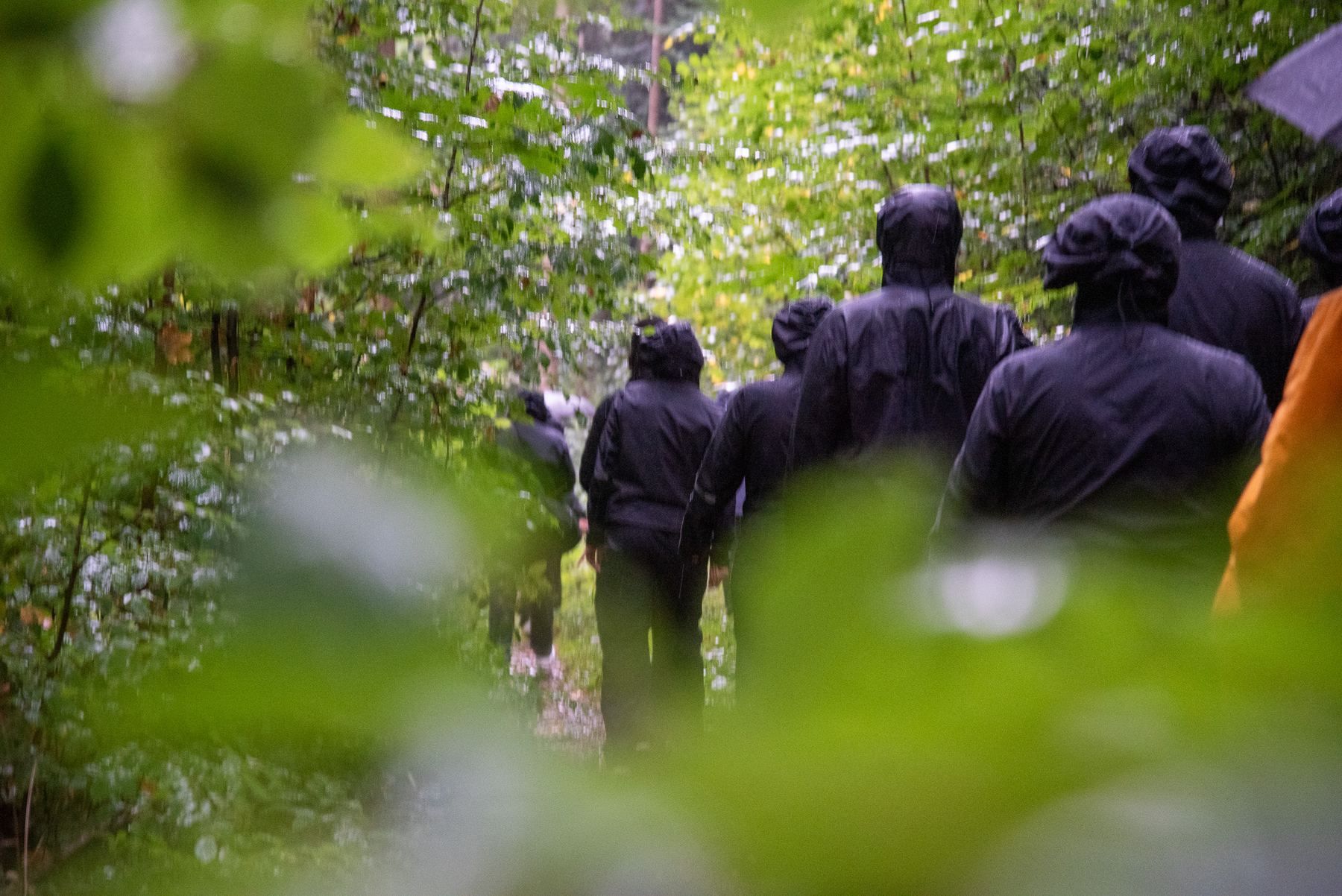
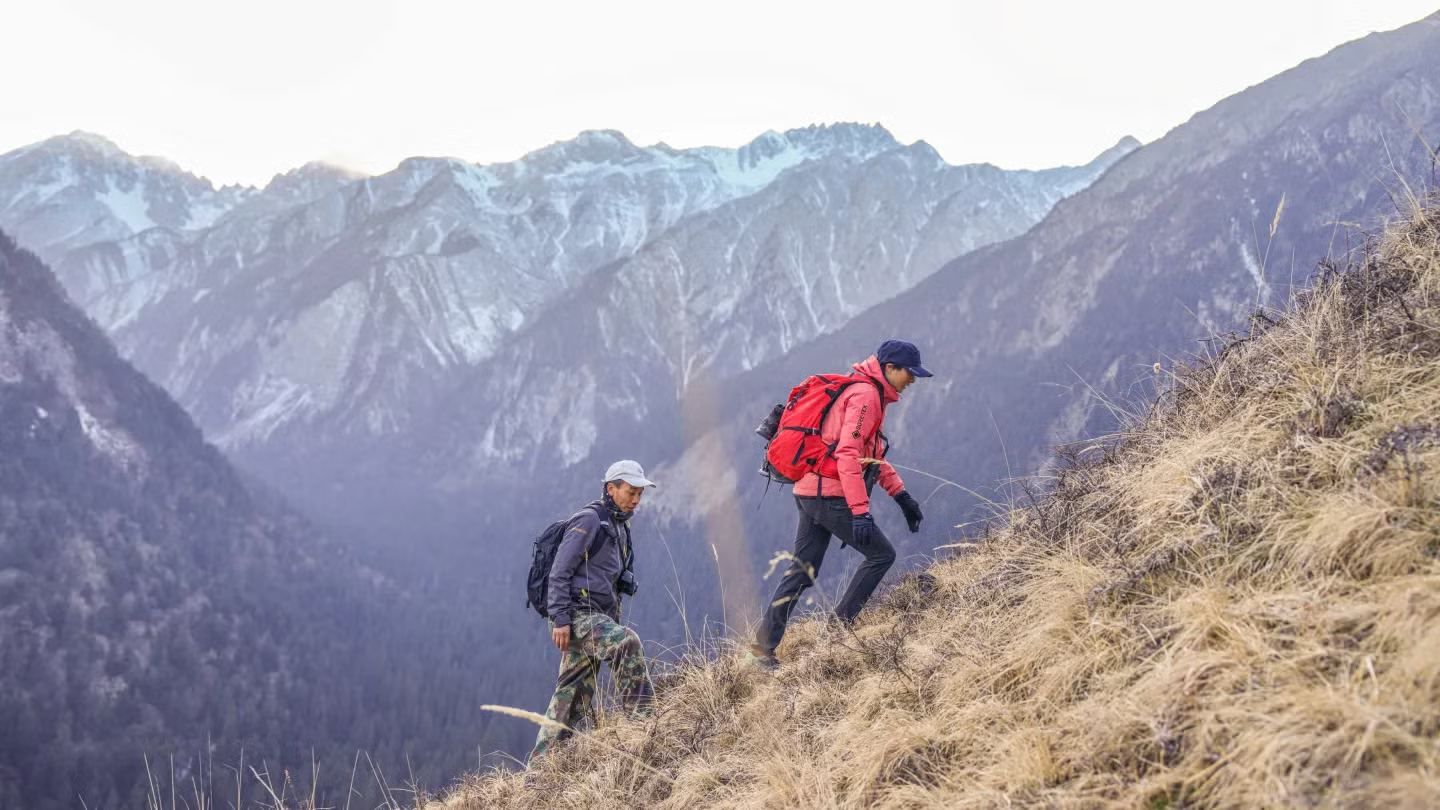
10 / 18The hike, in GORE-TEX jackets and footwear. 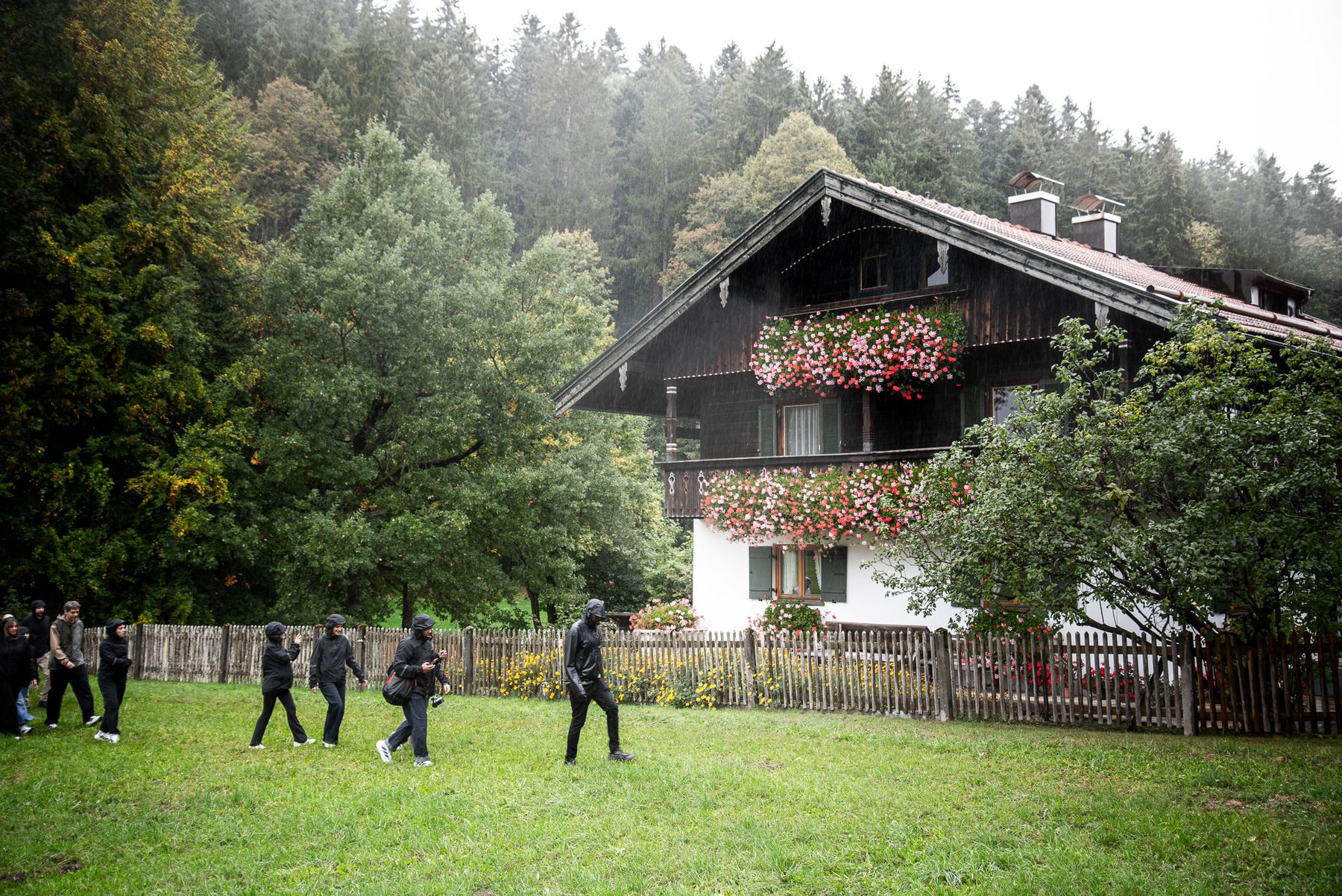
11 / 18A stop on the meadow. 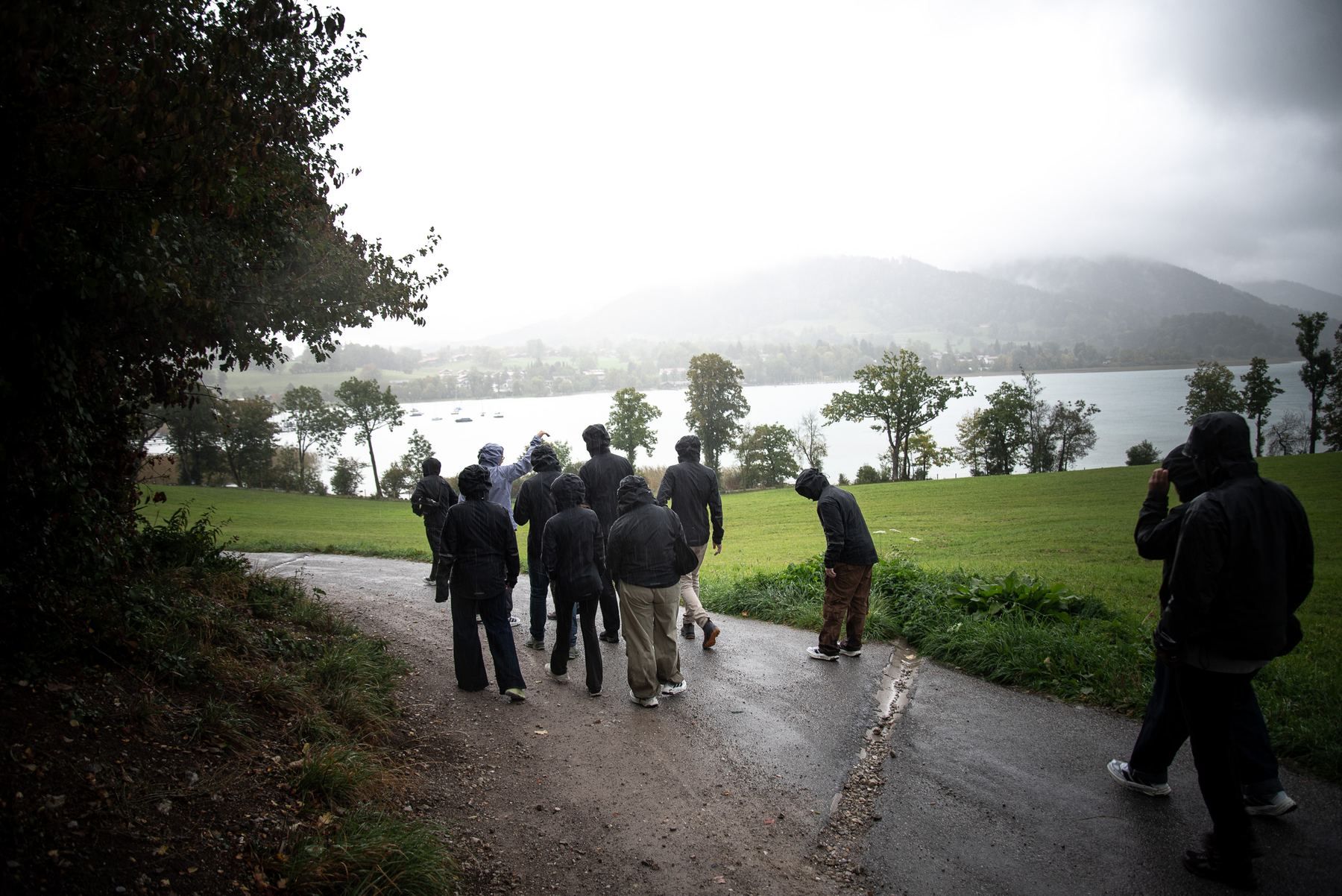
12 / 18Along the lake, in the rain. 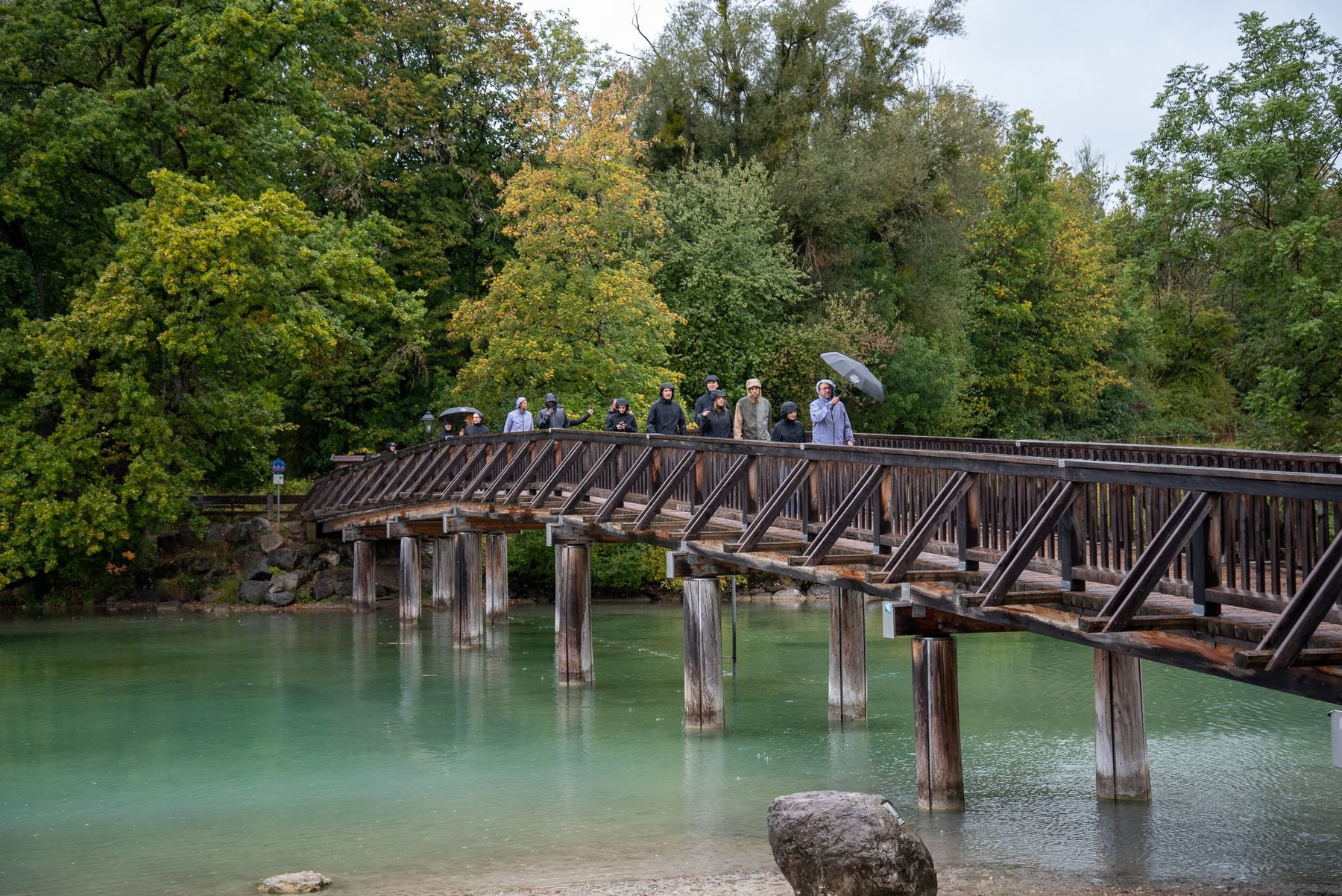
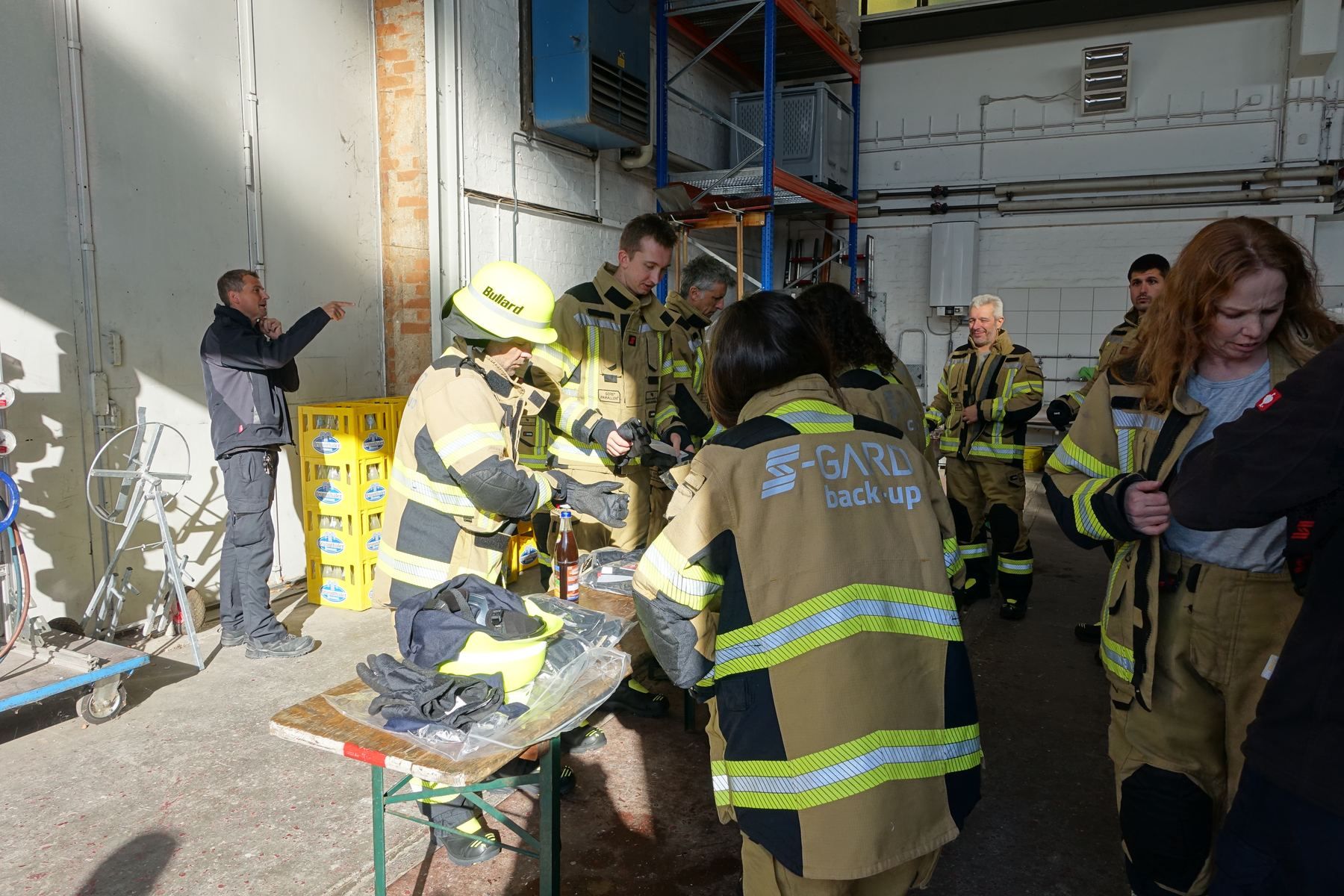
13 / 18The wooden bridge over the lake. 14 / 18At the fire station: kitting up and testing the uniforms. 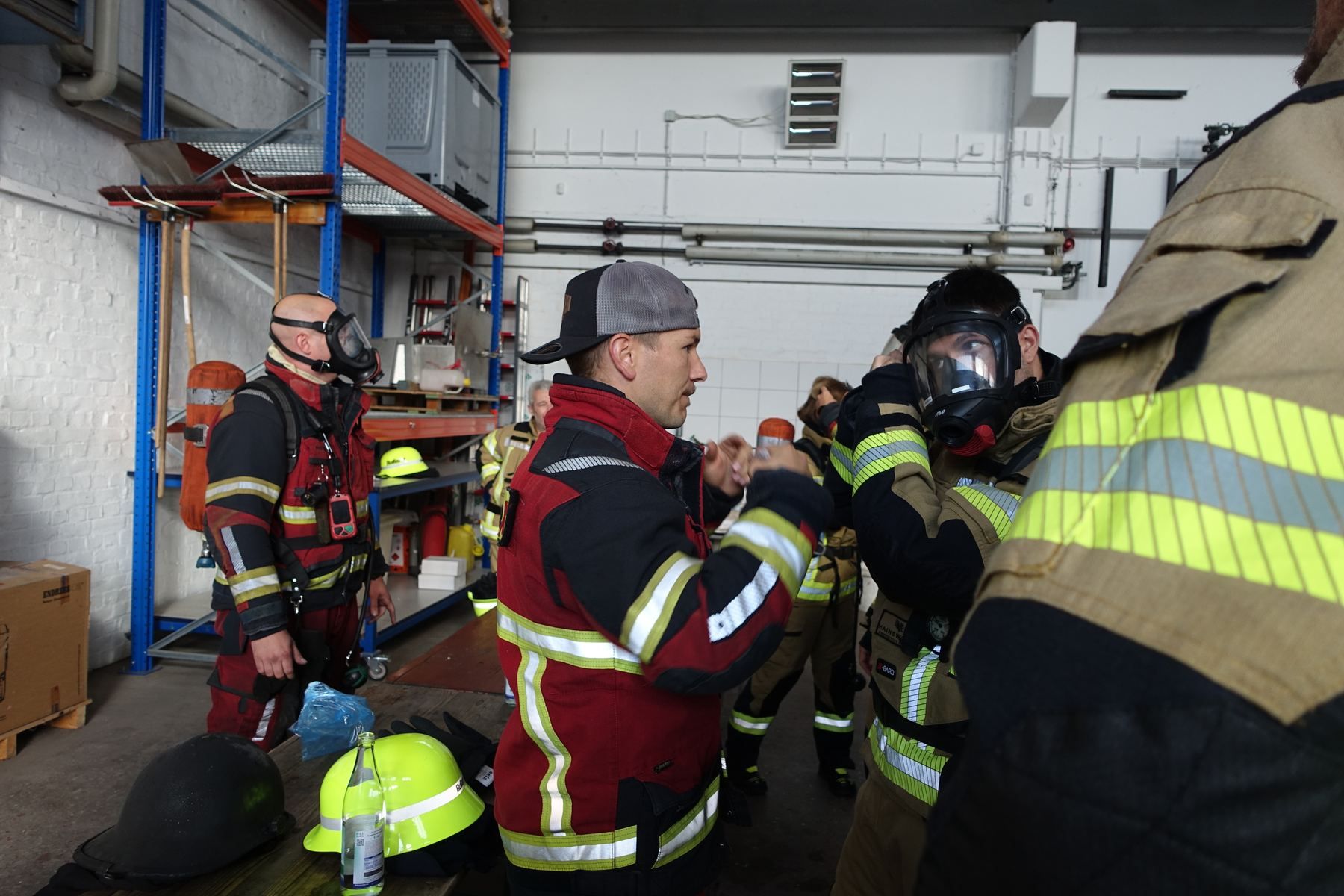
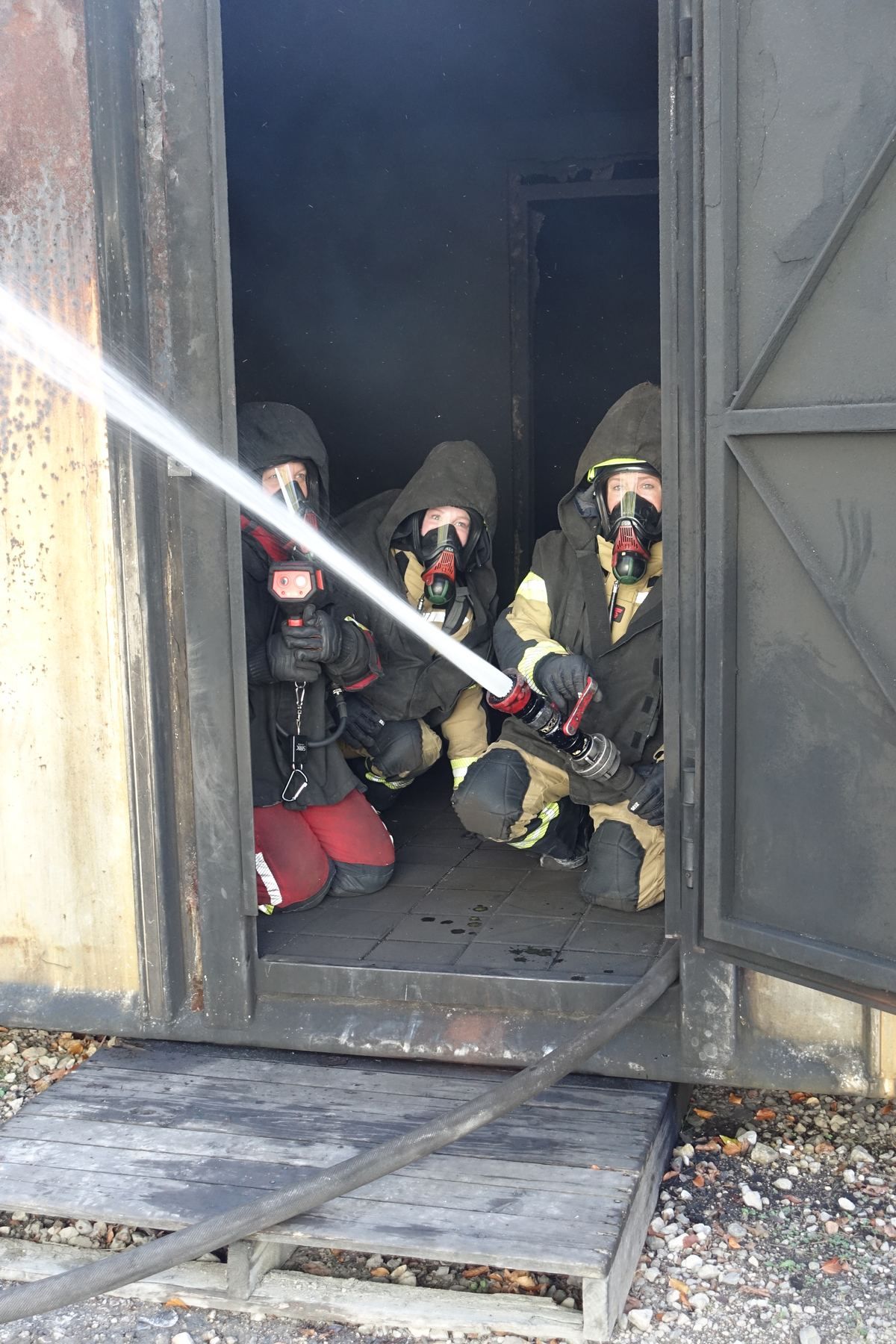
15 / 18Testing masks and breathing apparatus. 16 / 18A test with firefighting water in the container. 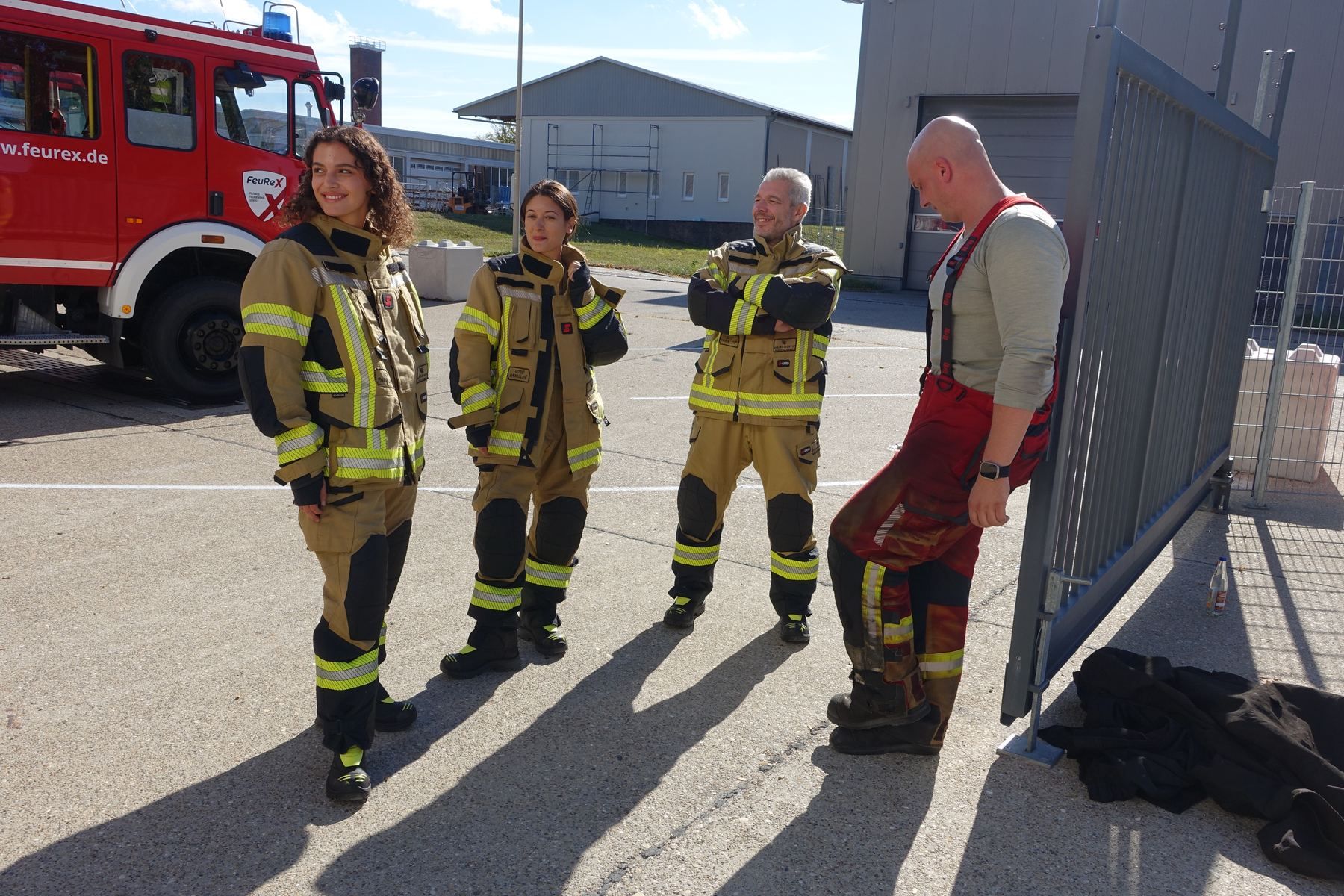
17 / 18Waiting to go ‘into action’. 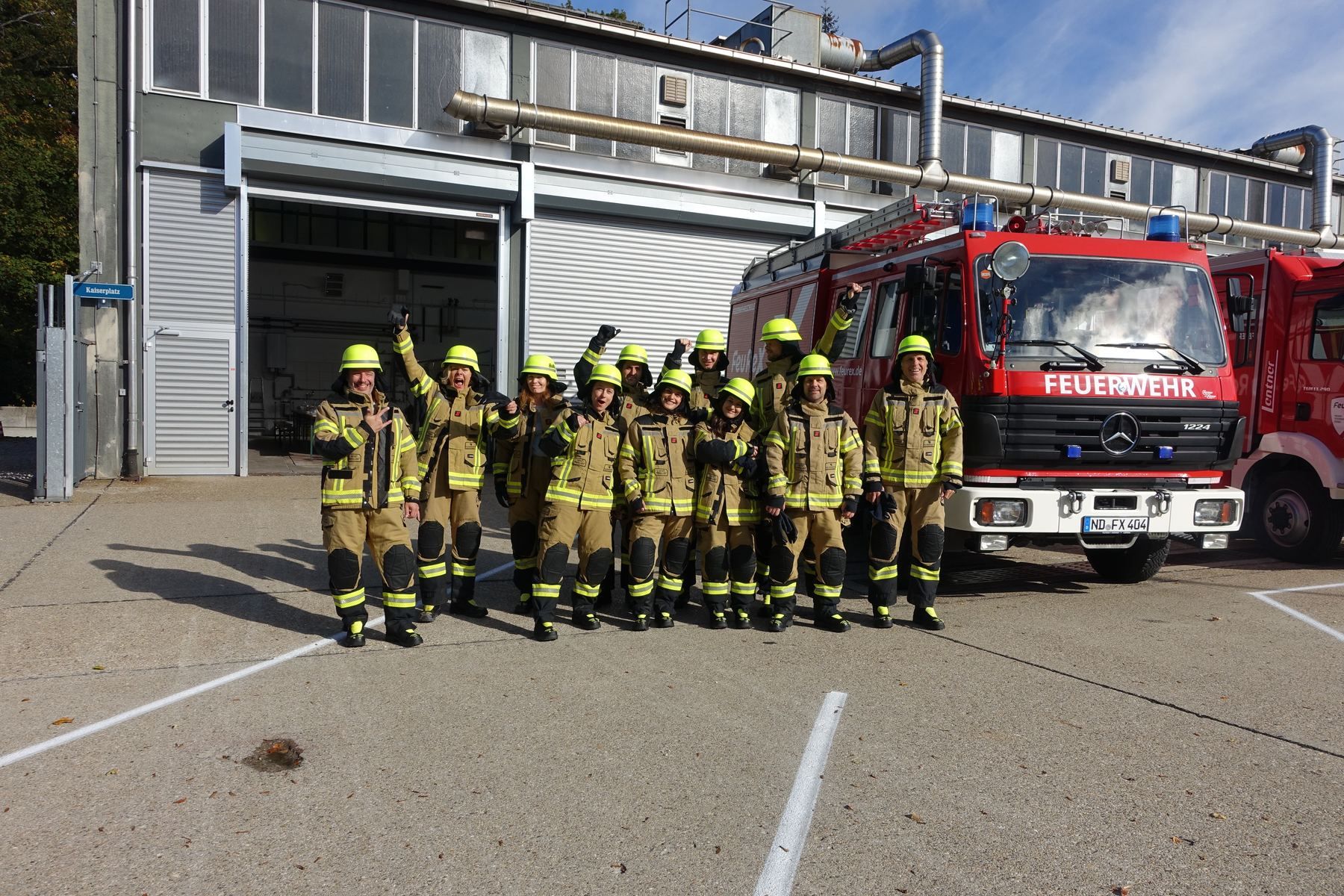
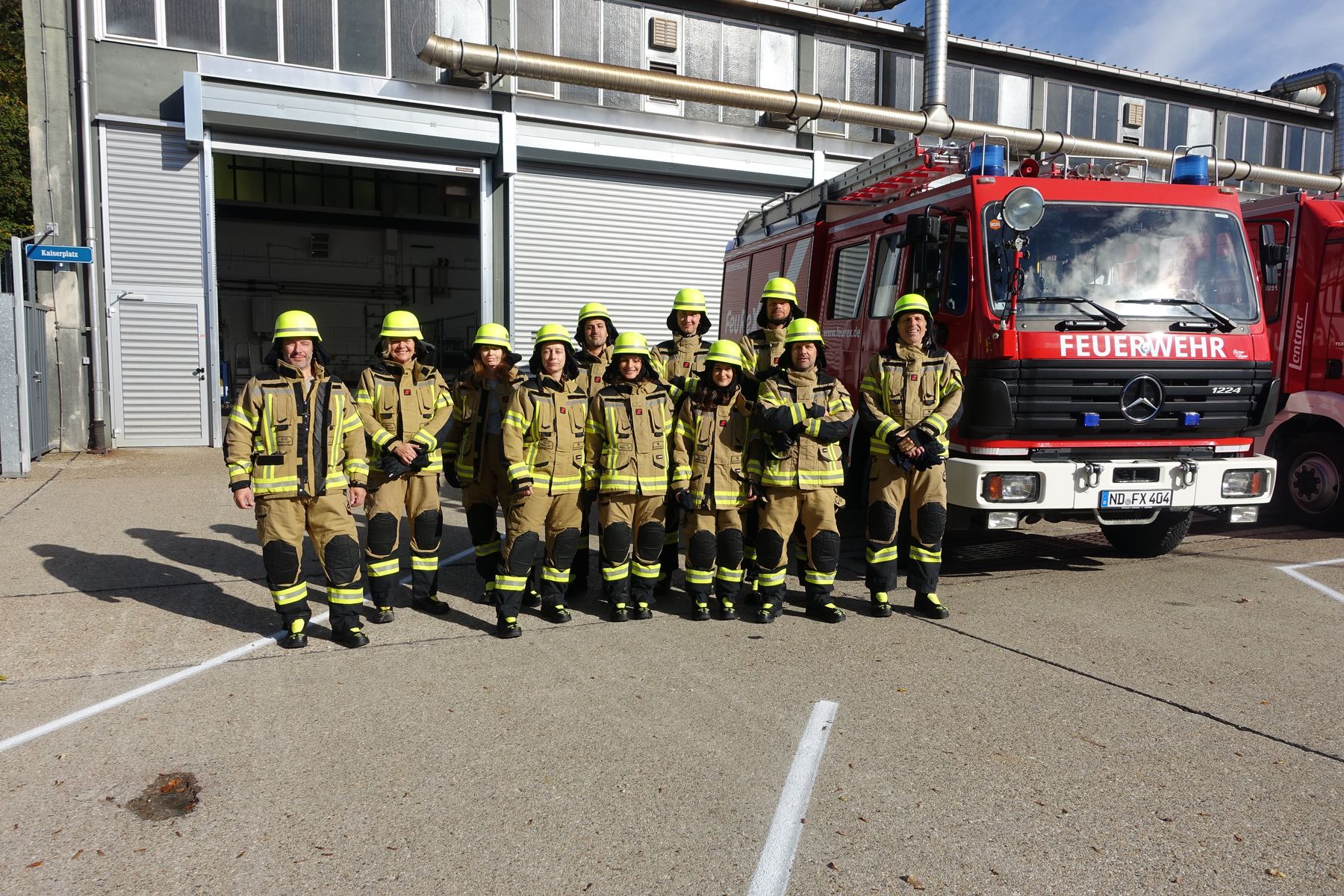
18 / 18The group of journalists in front of the rescue vehicles, ready to enter the containers to test GORE-TEX materials.